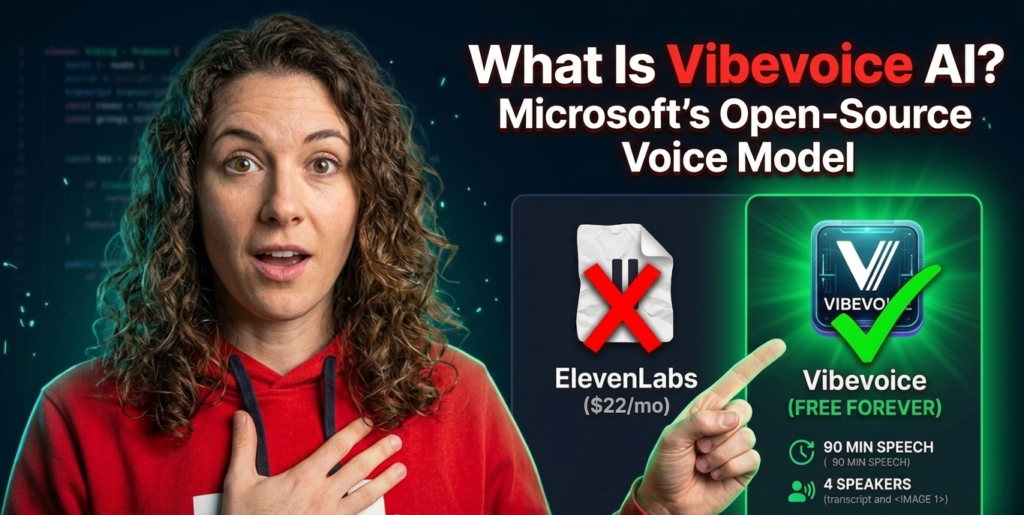
Audio content creation entered a new era on August 26, 2025, with the release of Microsoft’s open-source voice framework. Designed to overcome the limitations of traditional text-to-speech tools, this system generates up to 90 minutes of multi-speaker audio in a single pass. It represents a shift from short clips to industrial-scale audio production, handling both speech synthesis (TTS) and speech recognition (ASR) with unprecedented efficiency.
The Specialized Model Family: What is VibeVoice AI actually
The framework is comprised of three distinct models, each tailored for specific technical demands. According to Microsoft’s official project documentation, these models vary in parameter size to balance performance and speed.
| Model | Primary Task | Key Capability | Parameter Size |
| VibeVoice-TTS | Text-to-Speech | 90-minute multi-speaker audio | 1.5B / 7B |
| VibeVoice-Realtime | Streaming TTS | Live speech (300ms latency) | 0.5B |
| VibeVoice-ASR | Speech Recognition | 60-minute single-pass transcription | 7B |
The TTS variant supports up to four unique speakers and achieved significant academic recognition as an Oral at ICLR 2026. For developers building multi-agent AI systems, the Realtime-0.5B version is particularly relevant, delivering audible output in roughly 300ms, which is essential for natural human-AI dialogue.

Technical Innovations in Audio Architecture
The software’s ability to maintain high fidelity over long durations stems from a core engineering breakthrough: ultra-low frame rate tokenization.
- Tokenization Speed: By operating at just 7.5 Hz, the model cuts computational load while preserving audio quality.
- Next-Token Diffusion: Instead of predicting discrete tokens like standard language models, it uses a diffusion-based approach for richer, more natural sounds.
- Backbone Integration: The system leverages the Qwen2.5 LLM to manage dialogue flow and context.
- Consistency: It maintains distinct vocal identities for up to four speakers throughout an entire 90-minute session.
Insight: The shift to 7.5 Hz tokenization suggests that the future of audio AI is about efficiency and context-window management, not just raw parameter growth.
How to Use Vibevoice AI: Vibevoice AI Guide
Option A: Via Hugging Face (Easiest)
VibeVoice-ASR is integrated into Hugging Face Transformers v5.3.0+. Install and run in Python:
bash
pip install transformerspython
from transformers import pipeline

asr = pipeline("automatic-speech-recognition", model="microsoft/VibeVoice-ASR-7B")
result = asr("your_audio_file.wav")
print(result)
Option B: Via GitHub + vLLM (For Production Scale)
Clone the official repo: github.com/microsoft/VibeVoice
Use vLLM for faster inference, supported natively for both TTS and ASR variants.
Option C: Try the Playground
Microsoft’s official project page (microsoft.github.io/VibeVoice) includes a Playground for testing VibeVoice-ASR and Realtime models without setup.
Hardware requirements:
- VibeVoice-Realtime-0.5B: ~2GB VRAM (runs on RTX 3060 laptops)
- VibeVoice-ASR-7B: 12GB VRAM (with 4-bit quantization)
⚠️ VibeVoice is currently for research and development only, not approved for commercial deployment.
Practical Use Cases for Creators and Developers
This technology moves beyond simple voiceovers into complex, structured audio environments.
- Podcast Automation: Generate scripted long-form content with multiple host voices without a recording studio.
- Educational Content: Convert dense research papers or textbooks into multi-narrator audio, serving as powerful AI productivity tools for auditory learners.
- Meeting Intelligence: The ASR model transcribes full-hour recordings in one pass, accurately labeling speakers and timestamps.
- Game Development: Prototype character dialogue and narrative flow quickly before entering the booth with professional actors.

Implementation and Deployment
As noted in the Hugging Face Transformers documentation, the speech recognition variant is already available for developer integration via the Transformers library.
Python
from transformers import pipeline

# Example of running the 7B ASR model locally
asr = pipeline("automatic-speech-recognition", model="microsoft/VibeVoice-ASR-7B")
result = asr("your_audio_file.wav")
print(result)
For those interested in vibe coding or local production, the official code is available on GitHub. Hardware requirements vary: the 0.5B model runs on consumer laptops with 2GB VRAM, while the 7B variant typically requires 12GB of VRAM.

Comparison with Industry Competitors
In comparative benchmarks, the TTS variant outperformed Google Gemini 2.5 Pro TTS and ElevenLabs v3 (Alpha) in terms of realism and listener preference.
| Feature | Microsoft VibeVoice | Google NotebookLM | ElevenLabs v3 |
| Max Audio Length | 90 Minutes | ~30 Minutes | Short-form |
| Speaker Count | 4 | 2 | 1-2 |
| Access Type | Open Source | Closed Source | Closed Source |
Guardrails and Limitations
While the technology is advanced, Microsoft has implemented strict safety protocols. Every generated file includes an audible AI disclaimer and an imperceptible digital watermark for verification.
- Restricted Use: The models are currently for research and development only; commercial deployment is not yet permitted.
- Language Support: Speech-to-text supports 50+ languages, but text-to-speech is primarily limited to English and Chinese.
- Prohibited Actions: Use cases involving live voice conversion or real-time impersonation are strictly banned to prevent deepfake misuse.

Conclusion
Microsoft’s framework addresses a major gap in the AI landscape: the ability to generate and transcribe high-quality, long-form conversational audio within a single family of models. By prioritizing multi-speaker consistency and low-latency streaming, this toolkit provides a foundation for the next generation of auditory media, from interactive gaming to automated podcasting. As access expands, it is set to become a standard for creators looking to scale their audio content without sacrificing quality.