Google launched Gemini 3.5 Flash at Google I/O 2026 on May 19. According to Google’s public benchmark disclosures, it outperforms Gemini 3.1 Pro on coding and agentic evaluations while running significantly faster and at lower cost per token – an unusual inversion of the typical Flash/Pro capability hierarchy. This article breaks down what that actually means for developers making routing decisions, where the numbers hold up, and where the confidence should be lower.

The right model is not determined by benchmark rankings. It is determined by your actual workflow constraints. If you are routing agentic coding pipelines or building user-facing products, Gemini 3.5 Flash is almost certainly the better fit in mid-2026. If you need to process documents exceeding 1M tokens in a single request, or your task genuinely requires graduate-level scientific reasoning where accuracy margins matter, Gemini 3.1 Pro still has a clear role.
This comparison is for developers, AI builders, and technical teams actively routing workloads through the Gemini API who need to understand the architectural tradeoffs, not just which model scores higher on a leaderboard.
TL;DR Summary
- Best overall for most developers: Gemini 3.5 Flash – Google reports it outperforms Gemini 3.1 Pro on coding and agentic benchmarks, runs at roughly twice the output throughput, and costs less per token.
- Best for deep scientific reasoning: Gemini 3.1 Pro – benchmark data suggests it maintains an edge on graduate-level reasoning tasks (GPQA Diamond) and abstract generalization (ARC-AGI-2).
- Biggest limitation of Gemini 3.5 Flash: 1M token context ceiling versus Gemini 3.1 Pro’s 2M token support – a real constraint for large document ingestion pipelines.
- Biggest practical advantage of Gemini 3.5 Flash: Higher throughput and lower latency make it the only viable option for interactive, user-facing, or multi-step agentic products.
- Pricing reality: Gemini 3.5 Flash is priced at approximately $1.50 input / $9.00 output per 1M tokens; Gemini 3.1 Pro at $2.00 / $12.00 for standard context, with pricing that roughly doubles above 200K tokens.
- Who should use Gemini 3.5 Flash: API developers building agentic pipelines, coding assistants, multimodal apps, and high-throughput products where cost efficiency and response speed matter.
- Who should stay on Gemini 3.1 Pro: Research teams processing 1M+ token documents per request, or workflows where scientific reasoning accuracy has direct consequences and latency is acceptable.
Quick Comparison: Gemini 3.5 Flash vs Gemini 3.1 Pro
| Feature | Gemini 3.5 Flash | Gemini 3.1 Pro |
| Release Date | May 19, 2026 (Google I/O 2026) | February 19, 2026 |
| Context Window | 1M tokens | Up to 2M tokens |
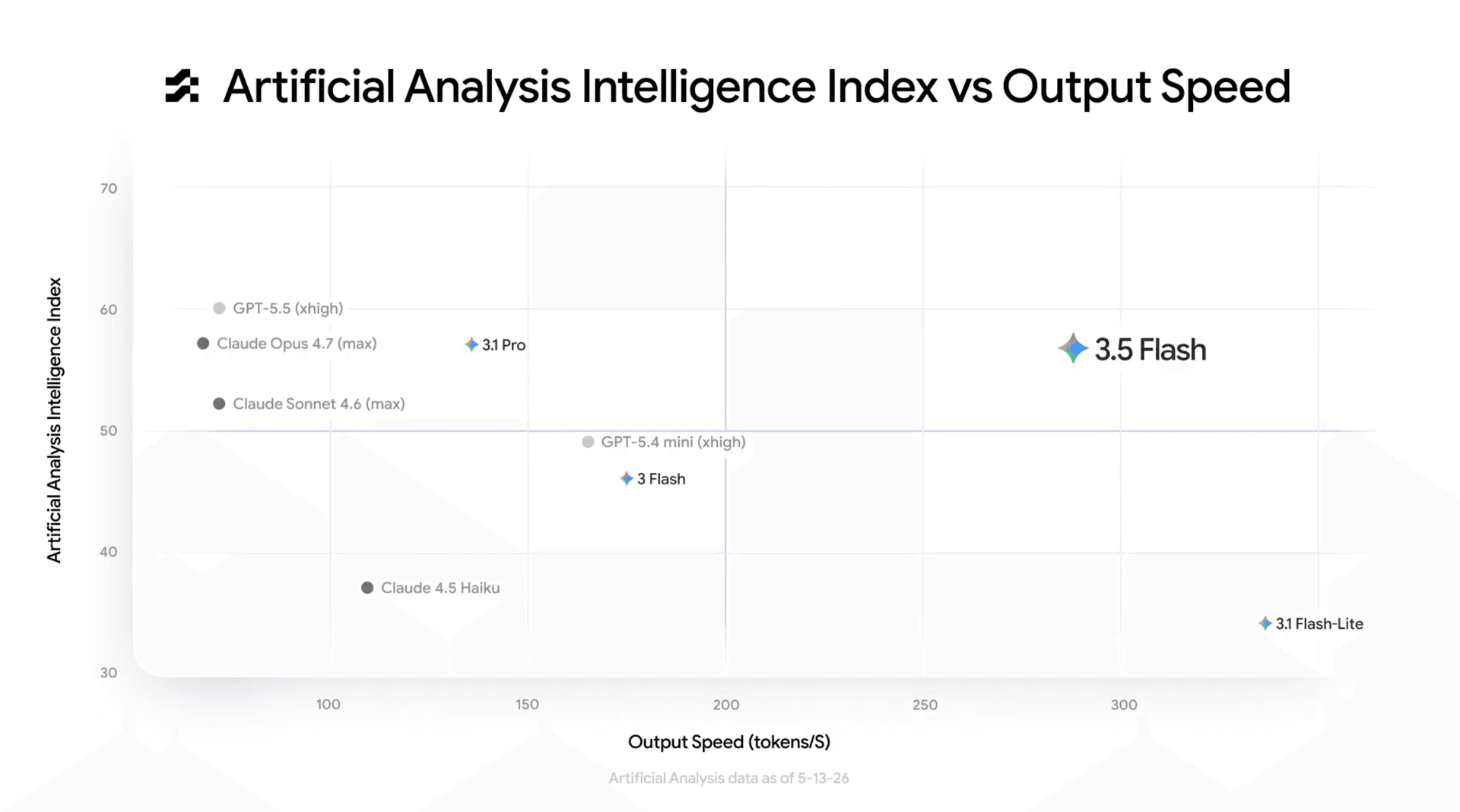
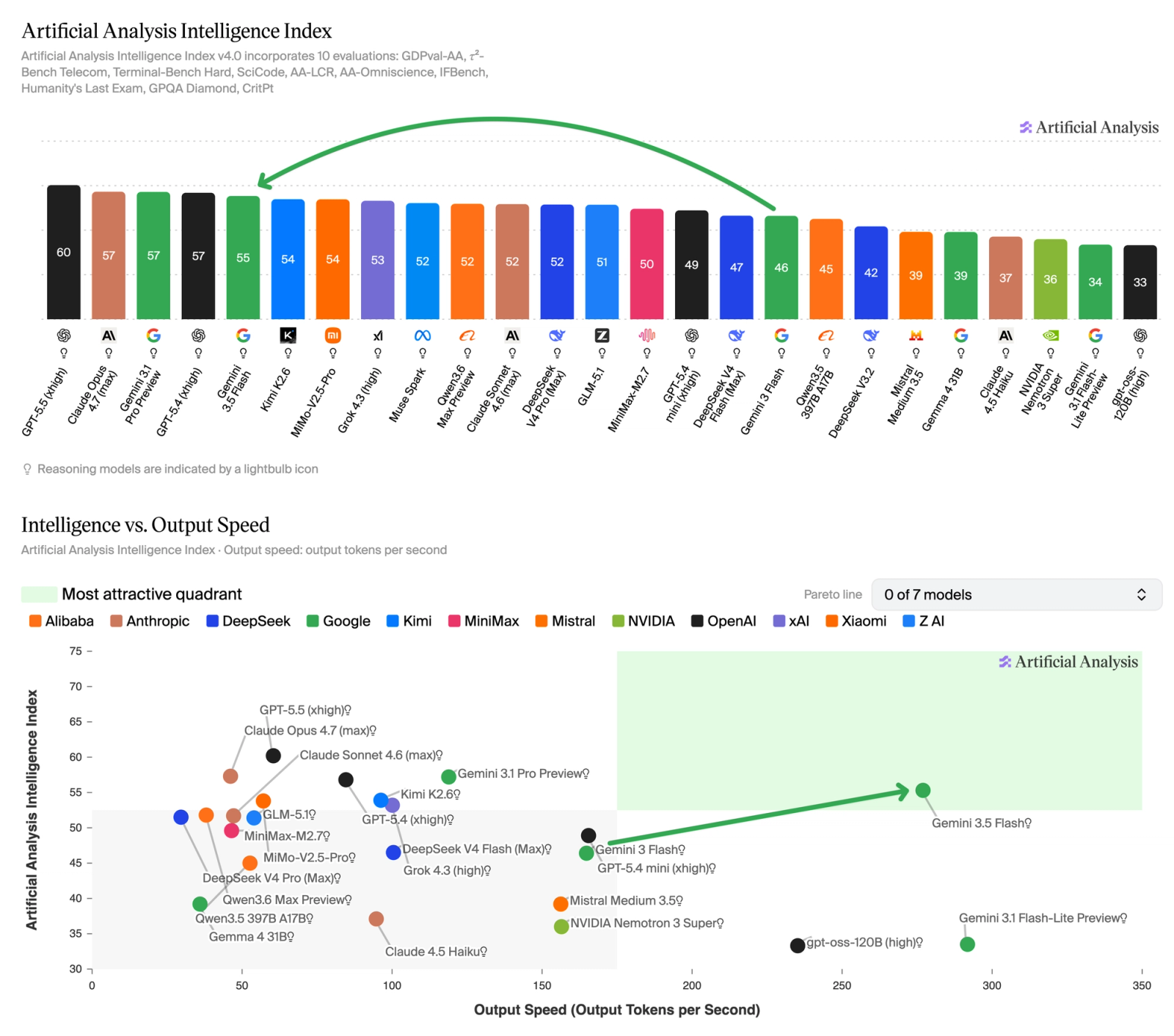
| Output Throughput | ~280 tok/s (Gemini API, per Google) | ~137 tok/s (per Artificial Analysis) |
| Latency Profile | Low; suited to interactive use | Can exceed 30s TTFT on complex reasoning tasks |
| Input Pricing (≤200K tokens) | ~$1.50 / 1M tokens | $2.00 / 1M tokens |
| Output Pricing | ~$9.00 / 1M tokens | $12.00 / 1M tokens |
| Terminal-Bench 2.1 (Coding) | 76.2% (per Google) | Lower than 3.5 Flash (per Google) |
| GDPval-AA (Agentic) | 1656 Elo (per Google) | Lower than 3.5 Flash (per Google) |
| GPQA Diamond (Scientific Reasoning) | ~92.2% | ~94.1–94.3% |
| ARC-AGI-2 | Not top-ranked | 77.1% |
| Multimodal Input | Text, image, video, audio | Text, image, video, audio, code |
| API Model ID | gemini-3.5-flash | gemini-3.1-pro-preview |
A few things the table does not capture: benchmark scores are measured under controlled evaluation conditions and do not map cleanly to all production workloads. Real-world performance depends heavily on prompting strategy, orchestration design, retrieval quality, latency tolerance, and tool integration. The comparison above describes benchmark behavior; your specific workload may differ.
- Gemini 3.5 Flash broke the typical Flash/Pro capability hierarchy on coding and agentic tasks – this is not just a faster, cheaper, weaker variant of Pro on those dimensions.
- Gemini 3.1 Pro holds its lead on pure scientific reasoning and offers the only 2M token context window currently available among production Gemini models.
- The throughput difference (~280 vs ~137 tokens per second) is roughly 2x, not 4x – a meaningful but not transformational gap for batch workloads, though it becomes significant in agent loops requiring sequential model calls.
- Pricing: above the 200K context threshold, Gemini 3.1 Pro input pricing doubles to $4.00/1M, creating a significant cost cliff for large-document pipelines.
Key Takeaways
- Gemini 3.5 Flash is the first model in Google’s Gemini 3.5 family, launched May 19, 2026 at Google I/O, and became the default model in the Gemini app and AI Mode in Google Search at launch.
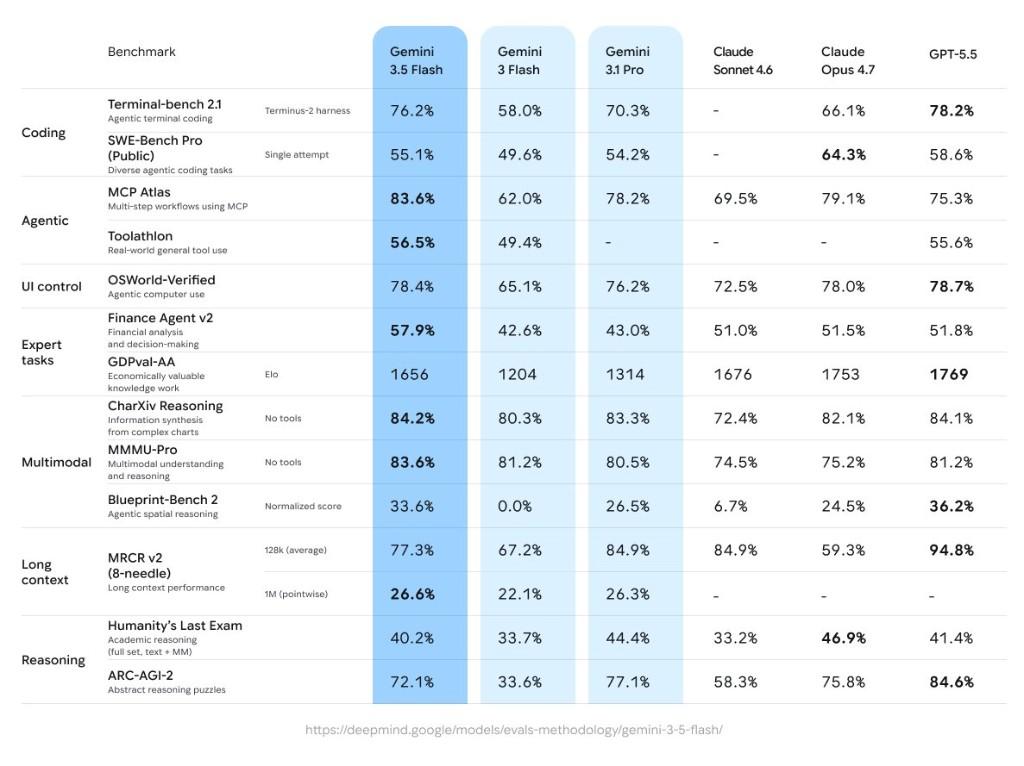
- According to Google’s public disclosures, Gemini 3.5 Flash outperforms Gemini 3.1 Pro on coding (76.2% Terminal-Bench 2.1), agentic tasks (1656 Elo GDPval-AA), and tool-use reliability (83.6% MCP Atlas).
- Gemini 3.5 Flash appears to run at approximately twice the output throughput of Gemini 3.1 Pro based on available benchmark data, making it better suited for latency-sensitive workflows.
- Gemini 3.1 Pro supports a 2M token context window and maintains a lead on graduate-level scientific reasoning benchmarks where reasoning depth matters more than throughput.
- Both models support full multimodal input: text, image, video, audio, and code in a single request.
- Gemini 3.1 Pro’s chain-of-thought reasoning runs by default, billing thinking tokens at standard output rates – a cost factor that does not appear in the quoted per-token rate and can significantly increase per-query cost on complex prompts.
- Benchmark scores suggest Gemini 3.5 Flash may translate to better production outcomes for coding and agentic workflows; whether that advantage holds for a specific workload requires direct evaluation rather than benchmark inference.
What Is Gemini 3.5 Flash?
Gemini 3.5 Flash is Google DeepMind’s first release in the Gemini 3.5 model family, announced at Google I/O 2026 and made generally available on May 19, 2026. The API model ID is gemini-3.5-flash, available in Google AI Studio, the Gemini API, Vertex AI, and Android Studio. Google describes the 3.5 family as combining “frontier intelligence with action” – framing the series as optimized not just for raw reasoning but for planning, tool use, and long-horizon agentic task execution.
What makes 3.5 Flash architecturally different from earlier Flash models is that Google specifically engineered it for agentic workloads: multi-step tool calling, subagent coordination, and maintaining coherence over extended task sequences. That design choice shows up directly in its benchmark profile – it leads on coding and agentic evaluations rather than abstract reasoning, which is the inverse of a typical Pro-tier model’s strength distribution.
Gemini 3.5 Flash Key Features
- Context window: 1,048,576 tokens – sufficient for large codebases, long transcripts, or multi-document research in a single request.
- Multimodal input: Handles text, image, video, and audio natively without requiring separate specialist models.
- Output throughput: Approximately 280 tokens per second on the Gemini API per Google’s reported figures = roughly twice that of Gemini 3.1 Pro based on independent benchmark data.
- Coding benchmark: 76.2% on Terminal-Bench 2.1, which tests code execution, debugging, and shell-level agentic coding performance (per Google’s I/O 2026 disclosures).
- Agentic benchmark: 1656 Elo on GDPval-AA, Google’s real-world agentic evaluation covering planning, tool calls, and multi-step task completion.
- Tool-use reliability: 83.6% on MCP Atlas, measuring correctness of tool call sequencing across scaled multi-tool pipelines.
- Safety design: Built under Google’s Frontier Safety Framework with stated improvements to cyber and CBRN safeguards, plus interpretability tools intended to check reasoning chains prior to output.
- Availability: Generally available on launch day with free access via Google AI Studio and pay-as-you-go pricing through the Gemini API.
Best for: Developers building agentic pipelines, coding assistants, high-throughput APIs, and user-facing products where response latency directly affects user experience.
What Is Gemini 3.1 Pro?
Gemini 3.1 Pro is Google’s frontier reasoning model released February 19, 2026, built for the most demanding enterprise and developer tasks: complex multi-step reasoning across very long documents, high-precision scientific analysis, and structured autonomous task execution. The API model ID is gemini-3.1-pro-preview.
Its defining feature is the combination of a 2M token context window with chain-of-thought reasoning that runs by default on complex tasks. Every sufficiently complex prompt routes through internal thinking before the model responds – which tends to increase accuracy on hard reasoning tasks but also increases both latency and cost compared to non-reasoning models. This is the right tradeoff for batch scientific workloads and not the right tradeoff for interactive applications.
Gemini 3.1 Pro Key Features
- Context window: Up to 2,097,152 tokens – the largest context window available among production Gemini models as of mid-2026, capable of processing approximately 1,500 A4 pages in a single request.
- Output limit: 64K output tokens per response.
- Reasoning: Chain-of-thought thinking runs by default on complex tasks. Thinking tokens are billed at standard output rates, which can significantly increase total cost on high-complexity prompts.
- Scientific reasoning: 77.1% on ARC-AGI-2 (abstract generalization) and approximately 94.1–94.3% on GPQA Diamond (graduate-level science) – areas where it maintains an advantage over Gemini 3.5 Flash based on available benchmark data.
- Latency: Time to first token can exceed 30 seconds on complex reasoning tasks depending on thinking budget, prompt size, and endpoint configuration. This varies significantly across use cases and should be tested against your specific workload before drawing conclusions.
- Output throughput: Approximately 137 tokens per second per Artificial Analysis benchmark data – above average for reasoning models at this price tier, but roughly half the throughput of Gemini 3.5 Flash.
- Pricing: $2.00/$12.00 per 1M input/output tokens for requests under 200K tokens; input doubles to $4.00/1M and output rises to $18.00/1M above that threshold.
Main limitation: On complex reasoning tasks, Gemini 3.1 Pro’s time to first token can exceed 30 seconds – a latency profile that makes it unsuitable for interactive or real-time applications regardless of its reasoning capability.
Benchmark Deep Dive: What the Numbers Actually Mean
Before reading any benchmark comparison, one caveat applies to everything below: benchmark scores measure narrow capabilities under controlled evaluation conditions. They do not predict production performance reliably across all workload types. Prompting strategy, retrieval design, tool integration, and orchestration architecture all affect real-world output quality in ways that benchmarks do not capture. Use these scores as directional signals, not guarantees.
Coding and Agentic Execution
- Gemini 3.5 Flash scores 76.2% on Terminal-Bench 2.1, which evaluates coding agents in a live shell environment including multi-file edits, debugging, and test execution – per Google’s public I/O 2026 disclosures.
- Gemini 3.1 Pro scores lower on Terminal-Bench 2.1, suggesting that Flash’s architecture changes specifically targeted execution-loop coding performance, not just benchmark optimization.
- The 1656 Elo on GDPval-AA indicates strong performance on multi-step agentic tasks requiring tool chaining, error recovery, and planning. Whether this translates to a specific production workflow depends heavily on how that workflow is structured.
- MCP Atlas (83.6%) measures reliability of tool call sequencing at scale – a particularly important metric for enterprise agent deployments where missed or malformed tool calls compound across long task sequences.
Scientific and Abstract Reasoning
- Gemini 3.1 Pro’s GPQA Diamond score (~94.1–94.3%) edges Gemini 3.5 Flash (~92.2%). A roughly 2-point gap on this benchmark may translate into meaningful accuracy differences for some high-precision scientific workflows – though the degree of transferability varies by domain and task structure.
- ARC-AGI-2 (77.1% for Gemini 3.1 Pro) tests novel pattern generalization rather than memorized responses. This is where deeper chain-of-thought reasoning tends to produce better outcomes than throughput-optimized architectures.
- For tasks like PhD-level research synthesis, clinical trial analysis, or complex legal reasoning under ambiguity, the Pro model’s reasoning depth is more likely to justify its latency and cost premium.
Latency and Throughput in Agent Workflows
This is where the operational difference between these models becomes most concrete. A multi-agent system making five sequential model calls compounds latency at every step. At Gemini 3.5 Flash’s throughput, five sequential calls can complete in a timeframe compatible with interactive workflows. At Gemini 3.1 Pro’s throughput with potential TTFT delays on reasoning-heavy tasks, the same five-call chain may take several minutes per cycle – making certain agentic architectures functionally impractical regardless of per-call reasoning quality.
This does not mean Gemini 3.1 Pro is wrong for agents. It means it is better suited for agent steps that run asynchronously, offline, or in verification roles rather than as the execution backbone of a real-time loop.
Pricing: What It Costs at Scale
| Model | Input ≤200K tokens | Output ≤200K tokens | Input >200K tokens | Output >200K tokens |
| Gemini 3.5 Flash | ~$1.50 / 1M | ~$9.00 / 1M | Not publicly confirmed | Not publicly confirmed |
| Gemini 3.1 Pro | $2.00 / 1M | $12.00 / 1M | $4.00 / 1M | $18.00 / 1M |
- At standard context (under 200K tokens), Gemini 3.5 Flash costs roughly 25% less on input and output compared to Gemini 3.1 Pro – a meaningful difference at scale.
- Gemini 3.1 Pro input pricing doubles above 200K tokens. For document-heavy RAG pipelines that regularly push past this threshold, the cost cliff is significant and worth modeling before committing to 3.1 Pro for that workload.
- Thinking tokens in Gemini 3.1 Pro are billed at standard output rates and do not appear in the quoted per-token price. High-complexity queries that generate large internal reasoning chains can substantially increase real cost per request.
- Batch/Flex API pricing for Gemini 3.1 Pro offers approximately 50% off for asynchronous processing, bringing it to $1.00/$6.00 per 1M at standard context – competitive for non-latency-sensitive research workloads.
- Google AI Studio provides free access to Gemini 3.5 Flash without a credit card, sufficient for prototyping and moderate-scale development testing.
For deeper context on how Gemini-native tooling integrates with API pricing decisions, our hands-on Gemini CLI comparison against Claude Code covers the developer tooling side of the Gemini ecosystem in detail.
Use Cases: When to Use Each Model
Use Gemini 3.5 Flash For
- Agentic coding assistants: Any workflow where the model writes code, executes it, reads output, and iterates – the Terminal-Bench 2.1 score reflects exactly this loop capability.
- Multi-step workflow orchestration: Planning across tools, subagent coordination, and maintaining task coherence over extended sequences where throughput and low latency are architectural requirements.
- User-facing and interactive products: Chatbots, real-time coding tools, search-augmented applications – any product where users wait for responses and latency directly affects experience quality.
- Multimodal pipelines: Tasks combining video, image, and text in a single request, such as UI bug analysis from screenshots combined with logs and specifications.
- High-volume API cost optimization: Replacing Gemini 3.1 Pro on workloads that do not require 2M context or deep scientific reasoning – the majority of enterprise API call volume by request count.
Use Gemini 3.1 Pro For
- Scientific research synthesis: Tasks requiring high accuracy on graduate-level science – biotech literature review, clinical analysis, or physics problem solving where the GPQA-indicated reasoning advantage may matter.
- 2M token document ingestion: Processing full multi-volume codebases, multi-year financial records, or book-length research documents that exceed 1M tokens in a single query.
- Abstract reasoning and novel generalization: ARC-AGI-2 style tasks where the model needs to generalize from examples not well-represented in standard training distributions.
- Asynchronous batch workloads: Using Batch API pricing ($1.00/$6.00 per 1M at standard context), Gemini 3.1 Pro becomes cost-competitive for overnight or non-real-time research processing where latency is irrelevant.
- Verification and review layers in hybrid architectures: Using Pro as a slower, deeper verification pass over outputs generated by Flash at high throughput – a pattern that combines the strengths of both models.
See also: Gemini Intelligence and Android AI agents explained – useful context on where Google is taking the broader Gemini ecosystem beyond the API.
What Most People Misunderstand About This Comparison
The most common mistake is treating Flash as a strictly inferior tier to Pro and defaulting to Pro for any “important” task. This assumption leads teams to pay a 25–30% cost premium and accept significantly higher latency for workloads where Gemini 3.5 Flash would produce equivalent or better results.
- Flash does not mean weaker: On coding and agentic benchmarks – which describe the majority of developer API workloads – Gemini 3.5 Flash appears to outperform Gemini 3.1 Pro. The Flash naming reflects architecture and pricing tier, not a universal capability downgrade.
- Speed is a workflow capability, not just a UX preference: The throughput difference changes what agent architectures are feasible. Multi-step agent loops that require five or more sequential model calls become structurally different products at different latency profiles.
- The 2M context window advantage is narrower than it sounds: Most production API requests never approach 1M tokens per call. The 2M ceiling of Gemini 3.1 Pro matters for a specific set of document-heavy enterprise workflows, not typical developer usage patterns.
- GPQA reasoning margins do not transfer universally: A 2-point gap on graduate-level science reasoning benchmarks may or may not translate to meaningful differences in business logic tasks, summarization, or structured data extraction. Assume transferability only after testing on your actual workload.
- Thinking token costs are hidden: Gemini 3.1 Pro’s true per-request cost is higher than the advertised per-token rate on any query that triggers substantial chain-of-thought reasoning. Budget accordingly.
I tested Gemini 3.5 Flash on a multi-step agentic task: parse a video transcript, extract action items, cross-reference them against a CSV of open tickets, and output a sorted priority list. Earlier Flash-tier models routinely failed the cross-referencing step or dropped context midway. Gemini 3.5 Flash completed all three steps on the first attempt without additional prompting. It was a small but representative signal that the architectural changes in the 3.5 series are more fundamental than a standard tuning update.
What Actually Matters When Choosing
| Workflow Factor | Favors Gemini 3.5 Flash | Favors Gemini 3.1 Pro |
| Response latency requirement | Interactive or real-time | Async, batch, or offline |
| Context window needed | Under 1M tokens per request | Over 1M tokens per request |
| Primary task type | Coding, agentic, tool use, multimodal | Scientific reasoning, large-doc RAG |
| Cost sensitivity | High throughput / cost-per-call matters | Low-volume, high-value reasoning tasks |
| Accuracy requirement | Business logic, code, summarization | PhD-level science, compliance-critical |
| User-facing product | Almost always the better fit | Latency profile typically incompatible |
- Switching friction is low: Both models share the same Gemini API SDK. Changing model IDs from
gemini-3.1-pro-previewtogemini-3.5-flashrequires one line of code. Run both on your actual task set before making a permanent routing decision. - Cost modeling at scale: A team running heavy agentic API workloads can reduce token costs meaningfully by defaulting to Flash and escalating to Pro only for identified high-reasoning tasks. The right split ratio is workload-specific and worth measuring rather than assuming.
- Hybrid architectures: The most sophisticated approach uses both models – Flash for high-throughput execution loops and Pro for async verification, deep research synthesis, or large document analysis. This pattern is increasingly common in production AI infrastructure teams.
- Forward trajectory: The Gemini 3.5 series appears to represent Google’s forward development path based on the I/O 2026 roadmap framing, though model availability and capability timelines beyond 3.5 Flash have not been publicly confirmed in detail.
Also relevant for developer tooling decisions: Grok Build CLI vs Claude Code comparison and Claude Code for vibe coding – useful if you are evaluating across ecosystems rather than committing fully to Gemini tooling.
Who Should NOT Use Gemini 3.5 Flash
- Teams whose workflows regularly exceed 1M tokens per request: The context ceiling is a hard constraint. If your pipeline ingests full document sets above 1M tokens, Gemini 3.1 Pro’s 2M window is currently the only Gemini option.
- Applications where PhD-level scientific accuracy is a hard requirement: If your output directly informs clinical decisions, scientific publications, or high-stakes compliance reviews, the reasoning depth advantage of Gemini 3.1 Pro warrants evaluation even at higher cost and latency.
- Teams with heavily optimized prompts built around 3.1 Pro’s reasoning behavior: Chain-of-thought by default affects how prompts interact with the model. Switching model IDs without re-testing prompts on your actual task distribution can produce inconsistent results.
- Abstract generalization tasks: ARC-AGI-2 style problems that require reasoning from novel examples favor deeper reasoning architectures over throughput-optimized ones.
Who Should NOT Use Gemini 3.1 Pro
- Any interactive or user-facing application: TTFT that can exceed 30 seconds on reasoning-heavy tasks is incompatible with products where users wait for responses. No reasoning accuracy advantage compensates for this at the UX level.
- High-throughput API pipelines: At roughly half the output throughput of Gemini 3.5 Flash, Gemini 3.1 Pro cannot sustain the volumes that large-scale agentic applications require without disproportionate infrastructure cost.
- Developers using Pro by default for standard coding or document tasks: On these workloads, Gemini 3.5 Flash appears to match or exceed 3.1 Pro quality at lower cost and higher speed. The reasoning depth premium is not justified for tasks that do not require it.
- Multi-agent systems with sequential execution requirements: Compounding latency across multiple agent steps makes Gemini 3.1 Pro impractical as the execution backbone of real-time agent loops.
- Cost-constrained early-stage teams: Start with Gemini 3.5 Flash. Escalate to Pro only after identifying specific tasks where it demonstrably outperforms Flash on your workload – not based on general assumptions about Pro-tier superiority.
Real-World Recommendation
- Best for beginners: Gemini 3.5 Flash via Google AI Studio – free, no credit card, full model access, and genuinely capable for learning, prototyping, and early-stage development.
- Best for production API development: Gemini 3.5 Flash on the Gemini API. Default to this. A/B test against your specific tasks before routing any subset to 3.1 Pro.
- Best for researchers and power users: Gemini 3.1 Pro via Vertex AI or the Gemini API for scientific reasoning and 2M context workflows. Use Batch API pricing for async workloads to reduce cost by approximately 50%.
- Best free option: Google AI Studio with Gemini 3.5 Flash – no cost barrier, suitable for development and moderate-scale prototyping.
- Best for enterprise teams: A hybrid routing architecture – Gemini 3.5 Flash as the execution layer, Gemini 3.1 Pro for async verification or large-document research layers where its reasoning depth and context window are actually needed.
- When to avoid Gemini 3.5 Flash: When your specific tasks require more than 1M context per call, or when you have tested on your actual workload and found that Gemini 3.1 Pro’s reasoning depth produces meaningfully better outputs for your use case.
- When to reconsider Gemini 3.1 Pro: If you are using it for interactive products, standard coding workflows, or any latency-sensitive application – test Gemini 3.5 Flash directly. The latency and cost savings are substantial and the quality difference on most practical tasks is likely smaller than the benchmark gap suggests.
For prompting strategies that affect which model tier you actually need in practice: our advanced prompt engineering guide covers techniques that can close quality gaps between model tiers on many task categories. And for a broader ecosystem view, our ChatGPT 5.5 analysis covers how GPT-5.5 compares to the Gemini family on similar agentic and coding benchmarks.
Frequently Asked Questions
Q. What is Gemini 3.5 Flash?
Gemini 3.5 Flash is Google DeepMind’s first model in the Gemini 3.5 family, released May 19, 2026 at Google I/O. It is a frontier-grade agentic and coding model that runs at approximately 280 tokens per second with a 1M token context window. Per Google’s public benchmarks, it outperforms Gemini 3.1 Pro on coding (Terminal-Bench 2.1) and agentic task evaluations (GDPval-AA) at approximately $1.50/$9.00 per 1M input/output tokens.
Q. Is Gemini 3.5 Flash better than Gemini 3.1 Pro?
On coding and agentic benchmarks, Gemini 3.5 Flash outperforms Gemini 3.1 Pro while running at roughly twice the throughput and at lower cost. Gemini 3.1 Pro maintains an advantage on graduate-level scientific reasoning (GPQA Diamond) and supports a larger 2M token context window. For most developer workloads, Gemini 3.5 Flash is the stronger practical choice.
Q. What are Gemini 3.5 Flash’s benchmark scores?
Per Google’s I/O 2026 disclosures: 76.2% on Terminal-Bench 2.1 (coding), 1656 Elo on GDPval-AA (real-world agentic tasks), 83.6% on MCP Atlas (tool-use reliability), and 84.2% on CharXiv Reasoning (multimodal understanding). These scores exceed Gemini 3.1 Pro on all agentic and coding evaluations. Note that benchmark scores are measured under controlled conditions and do not guarantee equivalent production performance.
Q. How much does Gemini 3.5 Flash cost?
Gemini 3.5 Flash costs approximately $1.50 per 1M input tokens and $9.00 per 1M output tokens via the Gemini API. Google AI Studio provides free access for prototyping without a credit card. This is roughly 25% cheaper per token than Gemini 3.1 Pro at standard context sizes, with the cost gap widening for long-context requests where 3.1 Pro pricing doubles above 200K tokens.
Q. What is the context window of Gemini 3.5 Flash?
Gemini 3.5 Flash supports 1,048,576 tokens (1M). Gemini 3.1 Pro supports up to 2,097,152 tokens (2M), which is the larger option for workflows that require processing very large document sets, codebases, or transcripts in a single request. The 2M ceiling is a genuine architectural differentiator for specific enterprise use cases.
Q. How fast is Gemini 3.5 Flash compared to Gemini 3.1 Pro?
Gemini 3.5 Flash runs at approximately 280 tokens per second (per Google’s figures). Gemini 3.1 Pro runs at approximately 137 tokens per second (per Artificial Analysis benchmark data) with a time to first token that can exceed 30 seconds on complex reasoning tasks. The throughput difference is roughly 2x, and the latency difference is most significant for agent workflows requiring sequential model calls.
Q. Can Gemini 3.5 Flash handle multimodal inputs?
Yes. Gemini 3.5 Flash handles text, image, video, and audio natively in a single request within the 1M token context window. It scored 84.2% on CharXiv Reasoning, a multimodal benchmark. Cross-modal tasks – analyzing a UI screenshot alongside a video recording and text specification – are a core design target for the model.
Q. Should I use Gemini 3.5 Flash or Gemini 3.1 Pro for coding?
Gemini 3.5 Flash is the stronger starting point for coding. It scores 76.2% on Terminal-Bench 2.1, surpassing Gemini 3.1 Pro, and is optimized for agentic coding workflows including multi-file edits and iterative debugging. Higher throughput also makes it better suited for coding assistant products where users wait for responses.
Q. Is Gemini 3.5 Flash available for free?
Yes. Gemini 3.5 Flash is available at no cost via Google AI Studio with no credit card required – sufficient for prototyping and development. Paid API access with higher quotas is available through the Gemini API at approximately $1.50/$9.00 per 1M input/output tokens.
Q. What is the difference between Gemini 3.5 Flash and Gemini 3.5 Pro?
Gemini 3.5 Flash is the fast, mid-cost tier in the Gemini 3.5 family, released May 19, 2026. Gemini 3.5 Pro is the larger flagship model in the same family, announced at Google I/O 2026 with broader availability expected later in 2026. Google indicated that 3.5 Pro is expected to push further on both reasoning and execution benchmarks, though specific public scores had not been released at the time of publication.
Q. How does Gemini 3.5 Flash compare to Claude Sonnet 4.6 and GPT-5.5?
Gemini 3.5 Flash competes directly with Claude Sonnet 4.6 and GPT-5.5 in the mid-tier frontier model category. Gemini’s differentiator is native multimodality across text, image, video, and audio in one model, plus tight integration with the Google ecosystem including Vertex AI, Google Workspace, and Android. Benchmark comparisons vary by task type; independent evaluations suggest Gemini 3.5 Flash holds an advantage on video-input multimodal reasoning specifically.
Conclusion
For most developers in mid-2026, Gemini 3.5 Flash is the right default. It outperforms Gemini 3.1 Pro on the benchmarks that describe real production workloads – coding, agentic execution, and tool-use reliability – at roughly twice the throughput and 25% lower cost. Google made it the default model across the Gemini app and AI Mode in Search because the performance/cost/latency profile fits the broadest range of use cases better than a deeper reasoning model does.
Gemini 3.1 Pro remains the right tool for a defined set of workflows: document ingestion above 1M tokens, graduate-level scientific reasoning where the GPQA accuracy margin may translate to real differences in output quality, and asynchronous batch workloads where the Batch API discount makes it cost-competitive. Outside those scenarios, defaulting to 3.1 Pro typically means paying more and waiting longer without measurable benefit.
The most important advice before deploying either model: test on your actual workload, not on benchmark summaries. The best free starting point is Gemini 3.5 Flash via Google AI Studio. Move to Gemini 3.1 Pro only after identifying specific tasks where its reasoning depth demonstrably improves outcomes for your use case – and factor latency into that evaluation from the start.
For further reading: Gemini CLI hands-on comparison, Gemini Intelligence for Android agents, and Google Omni for AI video workflows – all directly relevant to how the Gemini 3.5 model family is being deployed across Google’s broader product ecosystem.