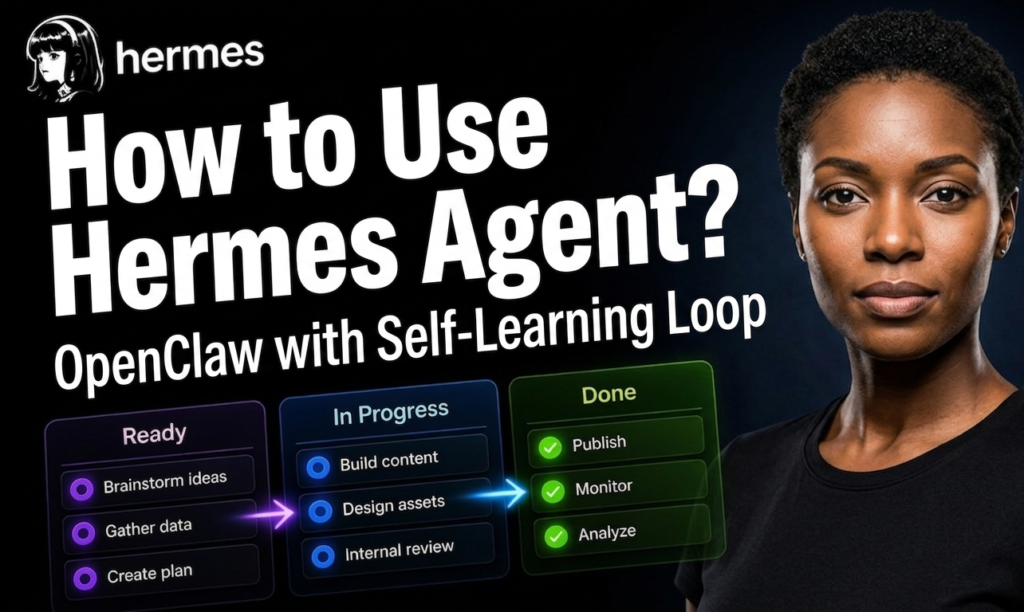
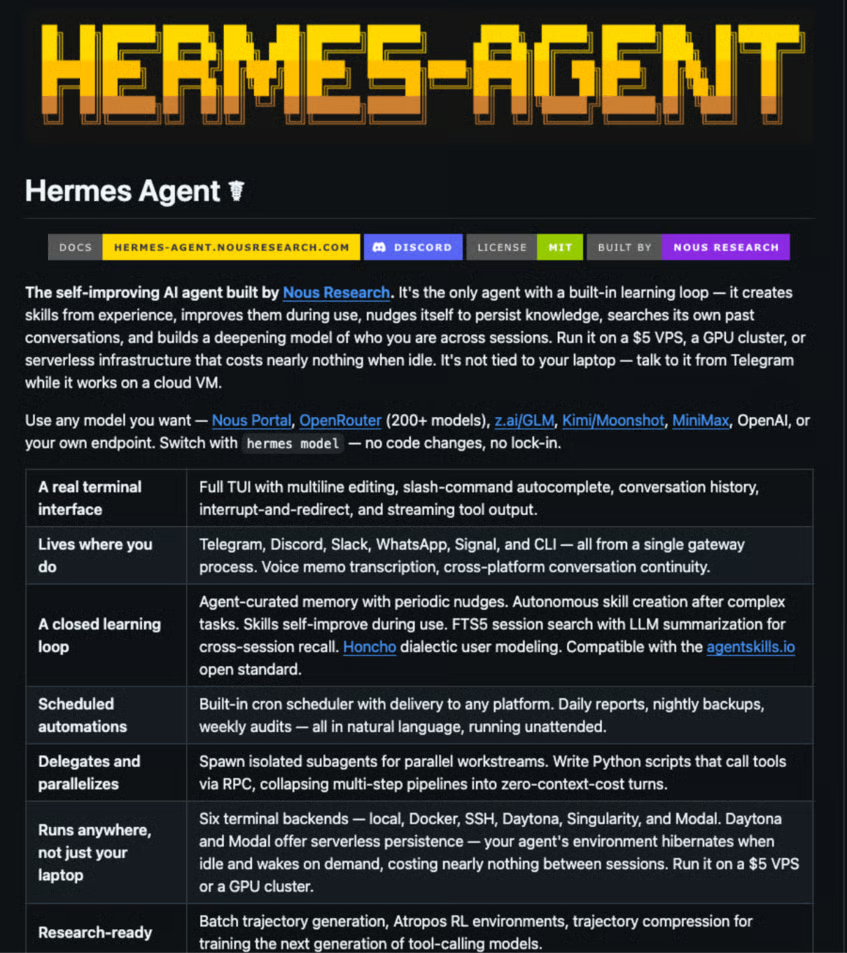
Hermes Agent, launched February 25, 2026 by Nous Research, is the fastest-growing open-source AI agent of 2026 – hitting 110,000 GitHub stars in ten weeks. Unlike OpenClaw, which executes tasks and stays static, Hermes runs a closed self-learning loop that makes the agent measurably better after every session. In this guide, we’ll cover what Hermes Agent is, how its self-learning loop works, how to set it up, and where it outperforms OpenClaw in real workflows.
What Makes Hermes Agent Different
Hermes Agent is a self-hosted, model-agnostic AI agent built around one principle: the agent improves through use, not configuration.
It was built by Nous Research – an open-source-first collective known for the Hermes model series, Atropos RL environments, and DisTrO distributed training. Their previous work on reasoning-capable, tool-using models fed directly into the agent’s architecture.
Where most agents (including OpenClaw) rely on human-written skill files and static memory, Hermes uses a closed feedback loop. Every task the agent completes becomes training data for its own future performance.
📌 Core design principle: Do → Learn → Improve. Repeat every session.
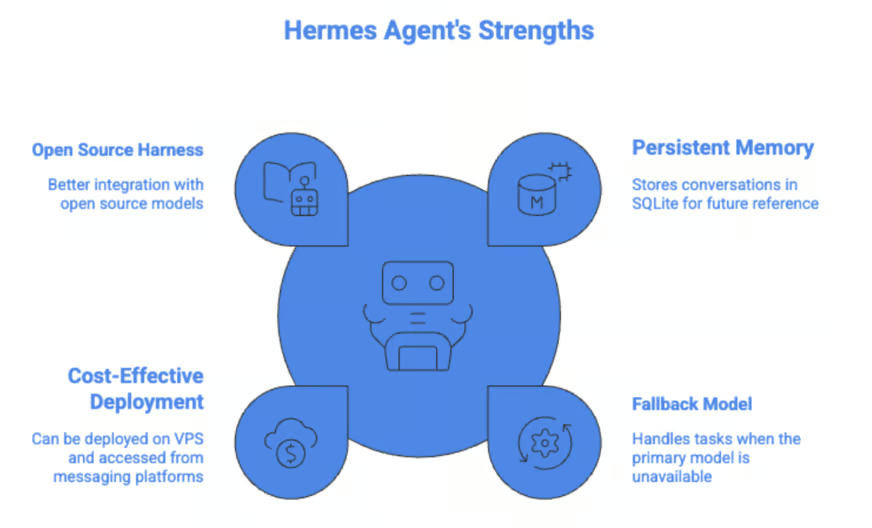
It is also fully model-agnostic – runs with Claude, GPT-4o, Gemini, DeepSeek, or local models via Ollama, without changing any application code.

How the Self-Learning Loop Works
This is the architectural bet that separates Hermes from everything else in 2026.
After completing a task, the agent runs an internal review cycle:
- Experience: Agent completes a multi-step workflow
- Extraction: It identifies reusable patterns from what it executed
- Skill Creation: Writes a new Markdown skill file automatically
- Refinement: That skill self-improves every time it’s used
- Nudge: Every 15 tasks, the agent reviews and updates its own knowledge base
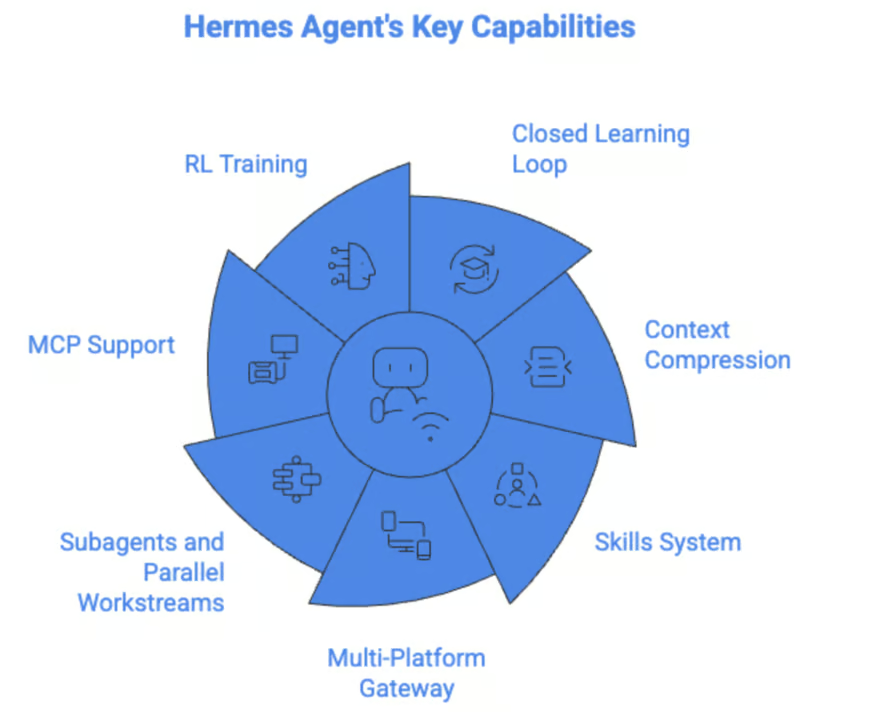
The result: an agent handling customer queries in March will perform measurably better by June – with no manual updates. Benchmarks from early 2026 show Hermes recovered from task errors 22% more effectively than OpenClaw in Long-Horizon Task tests.
Skills follow the open agentskills.io standard – not a proprietary format, keeping you portable.
ChatGPT is silently entering AI Agent’s Era: How to Make ChatGPT Agents: Create, Edit & Automate Tasks

How to Use Hermes Agent: Full Set-up
Hermes Agent is written in Python and runs on your own machine or server. Here’s the full Hermes Agent installation to get started:
Prerequisites
- Python 3.11+
- Git
- API key for your chosen LLM provider (Anthropic, OpenAI, etc.)
- Telegram bot token (or other messaging interface)
Installation Steps
Step 1: Clone the repository
git clone https://github.com/NousResearch/hermes-agent
cd hermes-agent
Step 2: Install dependencies
pip install -r requirements.txt
Step 3: Configure your environment
cp .env.example .env
# Edit .env: add your LLM API key, Telegram token, and preferred model
Step 4: Set your agent identity
Edit SOUL.md in the root directory. This file defines your agent’s persona, preferred behavior, and base instructions. Think of it as your agent’s system prompt that persists across every session.
Step 5: Run the agent
python main.py
Your agent is now running persistently. Connect to it via Telegram, Slack, Discord, or WhatsApp depending on what you configured.
Terminal Backend Options
Hermes supports 6 execution environments:
| Backend | Best For |
|---|---|
| Local | Development, personal use |
| Docker | Isolated production workloads |
| SSH | Remote server execution |
| Daytona | Dev environments |
| Singularity | HPC / research clusters |
| Modal | Serverless, scalable deployments |
Hermes Agent vs OpenClaw
| Feature | Hermes Agent | OpenClaw |
|---|---|---|
| Architecture | AIAgent loop-first | Gateway/control-plane-first |
| Skills | Auto-generated, self-improving | Human-authored, static |
| Skill Ecosystem | agentskills.io (open standard) | ClawHub (5,700+ community skills) |
| Memory | Layered (notes + session + user model + procedural) | Markdown files + SQLite |
| Security | Safer-by-default, no known critical CVEs | CVE-2026-25253 (CVSS 8.8), 9 CVEs in March 2026 |
| Language | Python | TypeScript/Node.js |
| Stars (Apr 2026) | 110,000+ | 345,000+ |
| Released | Feb 2026 | Nov 2025 |
| Migration Tool | Yes (from OpenClaw) | N/A |
| Model Support | Any (Claude, GPT, Gemini, Ollama) | Any |
| Terminal Backends | 6 | 2 (Local + Docker) |
💡 Bottom line: OpenClaw is a powerful tool you configure. Hermes Agent is an agent that gets better with use. The right choice depends entirely on your workflow philosophy.
OpenClaw's CVE-2026-25253 vulnerability - an unauthenticated remote code execution flaw with a CVSS score of 8.8 - exposed over 135,000 instances before a patch shipped. Hermes was designed with security as a default, not an afterthought.
Manus is Also in this AI Agent Race: OpenClaw vs Manus: Self-Hosted vs Cloud Autonomous AI
Top Hermes Agent Use Cases
🔁 Recurring Workflow Automation
Hermes supports cron-scheduled tasks that run in fresh sessions and deliver outputs automatically. Useful for: daily briefings, weekly reports, monitoring pipelines.
🧠 Codebase-Aware Development Assistant
Because Hermes stores procedural memory across sessions, it remembers your codebase's naming conventions, deployment pipeline, and schema details. You don't re-explain context every session.
📬 Intelligent Email and Task Management
Connect via Gmail or Outlook, and Hermes learns your response patterns over time. By week three, it handles routine correspondence with significantly less prompting.
📊 Research and Competitive Intelligence
Pair Hermes with web search tools, and the agent builds a compounding knowledge base on your target topics - surfacing patterns you'd miss in one-shot sessions.
🏢 Enterprise Workflow Orchestration
For teams, Hermes' ACP (Agent Communication Protocol) integration allows external tools like code editors and CI pipelines to communicate with the agent directly. Replaces several Zapier/Make workflows in a single persistent runtime.
Memory System Breakdown
Hermes uses a 5-tier layered memory stack - the most sophisticated of any open-source agent as of May 2026:
| Memory Layer | What It Stores |
|---|---|
| Persistent Notes | Agent-curated knowledge, survives all sessions |
| Session History | Full-text search (FTS5) with LLM summarization |
| User Modeling | Honcho dialectic model - deep understanding of the user |
| Procedural Memory | Methods, not just facts - stored as reusable skills |
| Hot/Cold Separation | Prompt memory vs archival - keeps token costs low |
As of v0.7.0 (April 3, 2026), memory is fully pluggable. You can swap in third-party backends - Honcho, vector stores, or custom databases - via a plugin interface. Six third-party providers are supported out of the box.
This architecture is what enables the self-learning loop described by Turing Post: experience is captured, proceduralized, and retrieved efficiently without inflating context windows.
Here's the Complete Breakdown of OpenClaw: What Is OpenClaw AI? HIDDEN Features, Uses & How to Use
Limitations to Know
Hermes Agent is two months old. Before adopting it in production, account for these:
- Smaller skill ecosystem: OpenClaw's ClawHub has 5,700+ community skills. Hermes relies on self-generated skills and a newer open registry.
- Python dependency: OpenClaw's Node.js base may be easier for frontend-heavy teams.
- Learning curve for self-improving behavior: The agent needs several sessions to start generating high-quality autonomous skills. Don't expect immediate gains on day one.
- Less community documentation: Most tutorials target OpenClaw. Hermes documentation is still catching up.
FAQ
Q: What is Hermes Agent used for?
Hermes Agent is used for autonomous task execution, recurring workflow automation, and long-horizon projects where the agent needs to retain and improve on contextual knowledge across sessions. Use cases range from personal productivity to enterprise workflow orchestration.
Q: Is Hermes Agent free?
Yes. Hermes Agent is open-source under the MIT license. You host it yourself and pay only for LLM API usage from your chosen model provider.
Q: How is Hermes Agent different from OpenClaw?
OpenClaw uses static, human-authored skills and a gateway-first architecture. Hermes Agent auto-generates its own skills through a closed self-learning loop and puts the agent's execution cycle at the center of its architecture. Hermes also has a significantly stronger security posture.
Q: Can Hermes Agent replace OpenClaw?
For users who want a self-improving agent with better security defaults, yes. For users who rely heavily on OpenClaw's ClawHub skill library or its Node.js ecosystem, migration requires planning. Hermes ships a dedicated OpenClaw migration tool.
Q: Does the Hermes AI agent work with Claude or GPT-4o?
Yes. Hermes Agent is fully model-agnostic. It works with Anthropic Claude, OpenAI GPT-4o, Google Gemini, DeepSeek, and locally hosted models via Ollama - switchable without changing application code.
Conclusion
Hermes Agent is the most architecturally ambitious open-source AI agent of 2026. Its self-learning loop solves the single biggest frustration with existing agents: context loss between sessions. If you're running workflows where the agent needs to accumulate expertise - codebase management, client communication, recurring research - Hermes is worth setting up today. OpenClaw remains stronger for teams who need a large pre-built skill library immediately.
The agent space is moving fast. Hermes Agent just made learning a first-class feature.
👉 Explore more AI agent breakdowns and tool comparisons on ZYPA's Blog.
Want to share your Hermes Agent setup or use case? Drop it in the comments below.