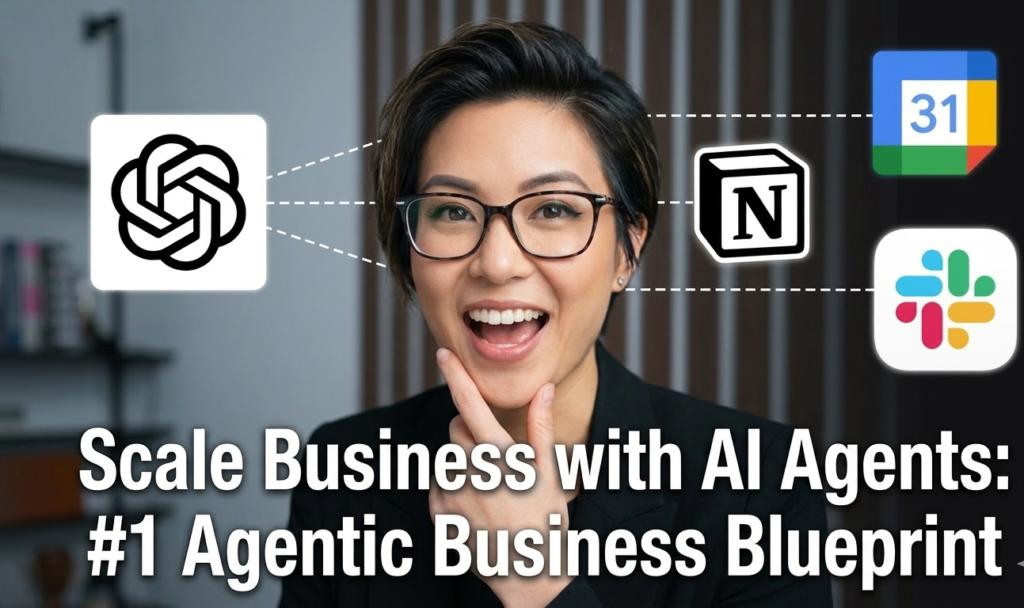
The way businesses operate is changing at a pace most executives haven’t fully grasped yet. Across industries, a new class of software is quietly replacing entire departments of repetitive cognitive work: AI agents. These are not simple chatbots or rigid automation scripts. They are goal-directed, decision-making systems capable of taking multi-step actions across apps, APIs, and databases with minimal human intervention. If you are trying to scale your business using advanced technology, understanding AI agents has never been more critical. Here we will teach you to scale business with AI agents.
According to McKinsey & Company, generative AI and intelligent automation could add up to $4.4 trillion annually to the global economy. The single largest driver of this massive economic shift is business process optimization.
“Insight: Businesses that understand AI agents now—how they work, what they can do, and how to deploy them—will own an enormous competitive advantage over the next five years.”
What Are AI Agents? (And Why They’re Different)
An AI agent is an autonomous software system that perceives its environment, makes decisions, and takes actions to achieve a specific goal without requiring constant human oversight. Unlike traditional automation, which relies on rigid, rule-based scripts, an AI agent operates dynamically.
An advanced AI agent can:
- Interpret natural language instructions.
- Break complex goals into manageable sub-tasks.
- Call external APIs, search the web, and even write and execute code.
- Adapt its approach based on real-time feedback.
Traditional automation is like a conveyor belt—predictable, linear, and brittle. In contrast, an AI agent functions more like a capable junior employee who reads the situation, problem-solves, and acts accordingly. By 2028, Gartner predicts that at least 15% of day-to-day business decisions will be made autonomously by AI agents, up from nearly zero in 2024.

Why AI Agent Workflow Automation Is a Game Changer
AI agent workflow automation refers to the use of AI agents to manage, execute, and optimize multi-step business processes from end to end, entirely eliminating human bottlenecks.
Consider a standard sales workflow: a lead comes in, gets qualified, researched, the CRM is updated, a follow-up email is drafted, and a meeting is scheduled. Traditionally, this requires five different software tools and two to three hours of manual human effort per lead. An AI agent can handle this entire sequence flawlessly in under three minutes.
According to Salesforce’s State of AI Report, companies implementing AI in their sales workflows report a 50% increase in lead conversion rates. Furthermore, these same companies cut operational costs by an average of 30%.
Key Components of Agentic Workflow Architecture:
- Planner: The core agent that breaks down a massive goal into ordered, logical sub-tasks.
- Executor: The specific agent or tool that carries out each individual task.
- Memory Layer: The system that stores context across sessions, utilizing both short-term and long-term data.
- Tool Use Layer: The framework integrating the agent with APIs, browsers, databases, and code interpreters.
- Supervisor/Orchestrator: The managerial layer that oversees multi-agent pipelines and actively resolves conflicts.

Top Use Cases: Where AI Agents Deliver the Most ROI
Not every business process requires an agentic overhaul. The highest ROI comes from automating workflows that are highly repetitive, data-heavy, time-sensitive, and require complex cross-system coordination.
- Customer Support Automation: AI agents seamlessly handle Tier-1 and Tier-2 support tickets. They can escalate complex issues intelligently, update CRM records, and send personalized resolution emails. According to Intercom’s 2024 benchmark data, agents achieve a resolution rate of over 80% for common queries.
- Marketing and Content Operations: Agents autonomously research trending topics, draft blog posts, schedule social media updates, A/B test marketing copy, and report on campaign performance—all within a single automated loop.
- Sales Intelligence and Outreach: From scraping LinkedIn profiles to crafting highly personalized cold emails and booking discovery calls, AI agents are revolutionizing outbound sales. HubSpot’s 2024 AI Trends Report reveals that 78% of sales teams using AI agents experienced faster pipeline velocity.
- Finance and Operations: Invoice processing, expense classification, vendor communication, and cash flow forecasting are now fully automatable by connecting agents to accounting APIs.

Best AI Tools for Business in the Agentic Category
If your goal is to use AI to scale your business, selecting the right agentic platform is the most crucial technical decision you will make.
- AutoGen (Microsoft): Ideal for complex multi-agent conversations and orchestration (Open Source / API).
- CrewAI: Best for deploying role-based agent teams designated for specific business tasks (Open Source).
- LangGraph: Perfect for building stateful, graph-based agent workflows (Framework).
- n8n + AI Nodes: A top-tier choice for visual, no-code agentic automation mapping.
- AgentGPT / OpenAgents: Designed for deploying quick, task-specific operational agents (SaaS).
- Relevance AI: An enterprise-ready business agent workforce builder (SaaS).
- Zapier AI: The industry standard for trigger-based automation featuring robust LLM actions (No-Code).
“Insight: For teams without a dedicated coding background, visual platforms like Relevance AI and n8n represent the best entry points because they mask complex agent capabilities behind intuitive drag-and-drop interfaces.”
According to a 2024 Forrester report, companies that deployed three or more AI agents in integrated workflows saw an average 41% reduction in operational overhead within just six months of deployment.

How to Build an Agentic Business Step by Step: Scale Business with AI Agents
Building an agentic business model does not require a massive engineering team. Any proactive business owner can follow this strategic roadmap:
- Step 1: Identify High-Friction Workflows. Map out your current processes and flag those that are repetitive, require multiple tools, and consume more than five hours per week across your team.
- Step 2: Choose Your Stack. Match your technical capability to the corresponding platform. Leverage no-code tools for immediate quick wins, or utilize LangGraph and CrewAI if you have developers to build custom pipelines.
- Step 3: Start with a Single Agent. Avoid the trap of trying to automate everything at once. Deploy a single, focused agent on one high-value workflow, such as lead qualification or content drafting.
- Step 4: Add Memory and Context. Enable your agent to remember past interactions to maintain proper context. This is the critical factor that separates a highly useful agent from a frustrating, one-shot tool.
- Step 5: Connect to Existing Tools. Utilize API integrations—like Zapier, Make, or native SDKs—to seamlessly bridge your agent with your CRM, email, calendar, and project management ecosystems.
- Step 6: Monitor, Evaluate, and Iterate. Establish strict performance benchmarks. Continuously track accuracy, calculate time saved, and monitor error rates while refining prompts and pipelines.
Challenges and Strategic Governance
Deploying autonomous agents introduces real-world technical and operational challenges that require proactive governance:
- Hallucination and Accuracy Risks: Agents can occasionally produce incorrect or fabricated outputs. Solution: Implement human-in-the-loop checkpoints for any high-stakes business decisions.
- Data Security: Agents frequently require deep access to sensitive internal systems. Solution: Secure your infrastructure using role-based API keys, comprehensive audit logs, and sandboxed testing environments.
- Tool Fragility: Autonomous agents can fail entirely when third-party APIs update or change unexpectedly. Solution: Hardcode fallback logic and robust error handling into every automated workflow.
- Scope Creep in Automation: Without strict boundaries, agents might take unintended actions outside their primary directive. Solution: Enforce tightly constrained tool permissions and explicitly define the agent’s absolute action space.
The MIT Sloan Management Review notes that 64% of enterprises currently cite a “lack of control and oversight mechanisms” as their top barrier to scaling AI agents. This makes comprehensive governance frameworks just as critical as the technical deployment itself.

Frequently Asked Questions (FAQ)
1. What is an AI agent in simple terms?
An AI agent is software capable of understanding a goal, planning the necessary steps to achieve it, utilizing tools and data, and completing the tasks autonomously. It functions similarly to how a human employee manages a multi-step project.
2. How can I scale my business with AI agents?
Begin by automating repetitive, high-volume workflows—such as customer support, lead qualification, or content production. Utilize platforms like CrewAI, n8n, or Relevance AI, measure the operational results, and expand your agentic footprint from there.
3. What’s the difference between an AI agent and a chatbot?
A chatbot strictly responds to user inputs in a conversational, turn-based format. An AI agent proactively takes actions, utilizes external tools, makes logical decisions, and completes multi-step tasks without waiting for constant conversational prompts.
4. How much does it cost to build an agentic business workflow?
Costs can range from $0 per month using open-source tools and basic API credits, up to $500–$2,000 per month for fully managed enterprise SaaS platforms with dedicated infrastructure.
5. What industries benefit most from AI agents?
Marketing, sales, customer support, finance, legal, healthcare administration, and e-commerce operations all see significant, measurable ROI from agentic automation.
Conclusion: The Agentic Shift Is Here
The transition toward an agentic business model is no longer a futuristic concept; it is an active, ongoing competitive battleground. Companies that master how to scale their business with AI agents today will operate with fundamentally superior cost structures, execution speed, and output capacity compared to late adopters.
“Insight: From AI agent workflow automation in complex sales pipelines to fully autonomous customer support systems, the best AI tools for business are finally accessible to teams of any size.”
The key to success is deliberate execution: choose one process, deploy one agent, measure the impact, and strategically expand. According to Deloitte’s AI Adoption Survey 2024, organizations that launched AI agent programs between 2023 and 2024 are already reporting a 2.5x faster operational scaling rate compared to those relying solely on traditional software automation.
The window for capturing this early adoption advantage remains open, but it will not stay open indefinitely. The agentic era has officially arrived, and the only question left is whether your business will lead the charge or scramble to catch up.
Ready to take the next step? Comment Down!
Read More awesome Blog Post on Our Blog.