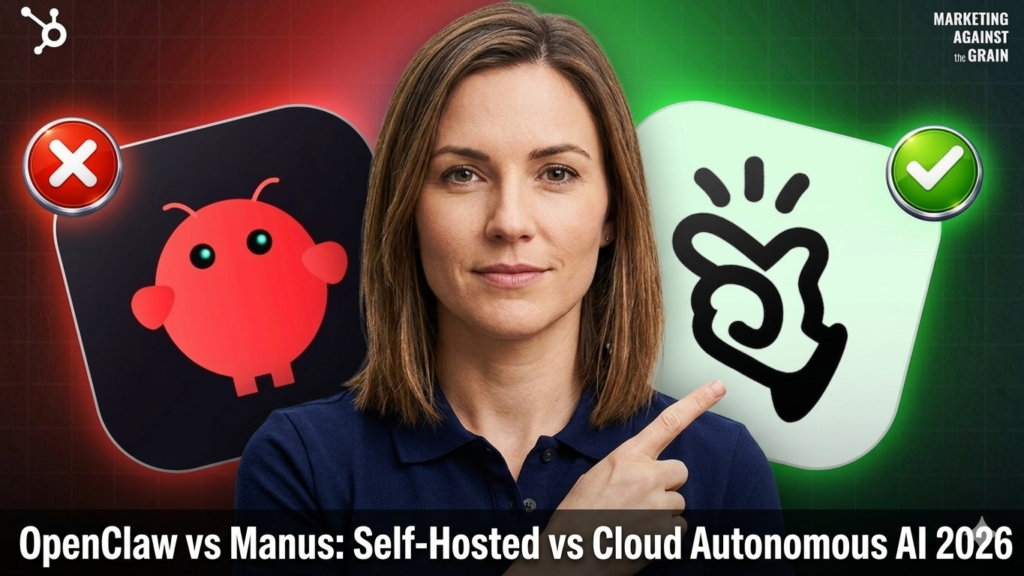
Two names consistently surface in this high-stakes infrastructure debate: OpenClaw vs Manus. Both represent powerful approaches to autonomous AI agents, yet they differ fundamentally in philosophy, architecture, and use case.
The race to build the most capable autonomous AI agent is no longer a Silicon Valley obsession — it has become a mainstream business decision. Whether you are a solo developer, a startup founder, or an enterprise IT team, choosing the right AI agent platform in 2026 could define how efficiently your organization operates for the next decade.
According to Gartner, autonomous AI agents are projected to handle over 40% of routine knowledge work by 2027. Furthermore, McKinsey & Company estimates that generative AI and agentic systems could add between $2.6 trillion and $4.4 trillion annually to the global economy.

What Are Autonomous AI Agents?
Before comparing platforms, it is crucial to define the technology. An autonomous AI agent is a software system powered by large language models (LLMs) that can perceive its environment, plan multi-step tasks, use tools like web browsers or code interpreters, and complete goals without human intervention at each step.
Unlike a simple chatbot that responds to single prompts, an agent executes chains of reasoning and actions to accomplish complex objectives. Asking an AI agent to research a market, draft a report, send it to stakeholders, and schedule a follow-up meeting is a prime example of autonomous agent behavior.
Insight: The shift from reactive chatbots to proactive agents represents the most significant leap in software capability since the advent of cloud computing. Organizations that fail to adopt agentic workflows risk immediate operational disadvantages.
What Is Manus? The Cloud-First Ecosystem
Manus is a general-purpose autonomous AI agent developed by Monica.im, a Chinese AI company. It gained explosive international attention in early 2025 as a direct competitor to OpenAI’s Operator and similar cloud-based agent systems.
Manus operates entirely in the cloud. Users interact with it through a polished web interface, and the agent handles tasks like web research, spreadsheet generation, code execution, travel planning, and document drafting autonomously.
This cloud-first design means zero installation friction. That seamless onboarding contributed significantly to its viral adoption, netting Manus over 400,000 waitlist signups within its first week of launch, according to TechCrunch.
However, this architecture comes with substantial enterprise trade-offs. The primary concerns center around data privacy, vendor lock-in, and ongoing subscription costs. Every task you delegate runs on Manus’s servers, meaning sensitive business data, proprietary workflows, and confidential documents are processed outside your infrastructure.

What Is OpenClaw? The Self-Hosted Standard
OpenClaw is an open-source, self-hosted AI agent framework that allows developers and organizations to deploy fully autonomous agents on their own infrastructure. This can be a local machine, a private cloud, or an on-premise server.
While Manus prioritizes ease of access, OpenClaw prioritizes control, transparency, and sovereignty over your AI stack. It draws from the same foundational agentic architectures—tool use, memory, multi-step planning—but gives you the freedom to choose your underlying LLM.
The appeal of a self-hosted AI agent like OpenClaw is especially strong in regulated industries—such as healthcare, legal, finance, and government—where data residency requirements make cloud-processed AI a legal or compliance risk.
OpenClaw vs Manus: Head-to-Head Comparison
To make an informed architectural decision, we must evaluate both platforms across infrastructure, cost, and extensibility.
1. Deployment and Data Sovereignty
- Manus: Operates exclusively as a cloud-only model. Data does not stay on your server.
- OpenClaw: Offers self-hosted or on-premise deployment. Data stays securely on your server. It also features offline capability when paired with a local LLM.
2. Cost Structure and Scaling
- Manus: Operates on a credit-based or subscription pricing model. For heavy users or enterprise teams, costs scale significantly.
- OpenClaw: Being open-source, it is free to deploy, with costs limited strictly to compute infrastructure and API token fees if using a hosted LLM.
- According to AI Tool Report, enterprises running 500+ daily agent tasks could save between $3,000 and $8,000 per month by switching to a self-hosted solution like OpenClaw.
3. Performance and Extensibility
- Manus: Benefits from heavily optimized cloud infrastructure with global edge distribution, ensuring low latency for most users.
- OpenClaw: Performance is entirely dependent on the hardware and LLM you choose. However, because it is open-source, developers can write custom tools, extend the memory system, integrate proprietary databases, or create specialized agents tailored to industry workflows.

The Critical Factor: Cloud AI Agent Security
One of the most underappreciated dimensions of this debate is cloud AI agent security.
When you use Manus or any cloud-based agent, every task execution passes through the provider’s infrastructure. This includes the content of your prompts, accessed files, intermediate reasoning steps, and API credentials used as tools.
Routing that information through external AI infrastructure introduces non-trivial risk. IBM’s 2025 Cost of a Data Breach Report found that the average cost of a data breach reached $4.88 million.
Prompt injection vulnerabilities are currently among the most active threat vectors for autonomous agents. A malicious webpage could embed hidden instructions designed to hijack the agent’s behavior to exfiltrate data. While both platforms face this challenge, OpenClaw allows security teams to implement custom prompt sanitization layers and monitoring at the infrastructure level.
Furthermore, access control and audit logging are significantly easier to enforce with self-hosted systems. Organizations running OpenClaw can integrate it directly with their existing IAM systems to maintain complete audit trails.
Insight: The true cost of a cloud-based AI agent isn’t just the API or subscription fee—it is the compounding risk of data exposure and the loss of intellectual property sovereignty.

OpenClaw Tutorial: Deploy Your Agent in 30 Minutes
For teams ready to take control of their AI infrastructure, deploying OpenClaw is straightforward.
Step 1: Prerequisites
- Ensure you have a Linux, macOS, or Windows (WSL2) machine.
- Install Python 3.10 or higher.
- Have at least 8GB RAM available.
Step 2: Clone and Install Pull the repository and install the required core framework and memory management libraries.
Bash
git clone https://github.com/openclaw-ai/openclaw
cd openclaw
pip install -r requirements.txt
Step 3: Configure Your LLM Backend Open the config.yaml file to set your model provider (e.g., OpenAI, Anthropic, or Ollama).
YAML
llm:
  provider: openai
  model: gpt-4o
  api_key: YOUR_API_KEY
Step 4: Launch and Assign Tasks Run python main.py to initialize the tool registry and memory layer. You can then assign a complex goal, such as researching electric vehicle market caps and saving a formatted PDF report. Watch OpenClaw autonomously plan steps, browse the web, and save the output.

Frequently Asked Questions
1. What is the main difference between OpenClaw and Manus?
OpenClaw is an open-source, self-hosted AI agent framework you deploy on your own infrastructure, while Manus is a cloud-based autonomous agent operated by Monica.im’s servers. The core trade-off is control and privacy (OpenClaw) versus ease of use and managed experience (Manus).
2. Is OpenClaw free to use?
Yes. OpenClaw is open-source and free to download and deploy. Your costs are limited to compute infrastructure and any LLM API usage fees.
3. Can OpenClaw run without internet access?
Yes, if you configure it with a local LLM through a tool like Ollama, OpenClaw can operate in a fully air-gapped environment.
4. What LLMs can OpenClaw work with?
OpenClaw supports any OpenAI-compatible API endpoint, which includes GPT-4o, Claude, Mistral, Llama 3, and Gemma. Local model support via Ollama is also built-in.
5. Are autonomous AI agents safe for business use?
Autonomous agents are powerful but require guardrails. Best practices include running agents with least-privilege access, reviewing outputs before final execution, and implementing prompt injection defenses.
Conclusion: Which Platform Is Right for You?
The OpenClaw vs Manus debate ultimately comes down to a fundamental question: do you value convenience or control?
Manus delivers a polished, accessible experience that lowers the barrier to entry for autonomous AI agents dramatically. For individuals exploring what AI agents can do without committing technical resources, it is an excellent starting point.
But for developers, enterprises, and builders serious about long-term deployment in 2026, OpenClaw’s self-hosted architecture offers complete ownership of your AI infrastructure, your data, and your agent’s behavior. As cloud AI agent security concerns grow, the value of a self-hosted, auditable, customizable agent framework will only increase.
OpenClaw is not just a tool; it represents a philosophy of AI deployment that prioritizes trust, transparency, and independence.
See more Awesome Posts on Our Blog…