The open-source AI race just got significantly more competitive. In April 2025, Google DeepMind launched Gemma 4, the latest generation of its lightweight, open-weight model family — and the specifications are turning heads across the industry. At a time when developers, enterprises, and researchers are hungry for powerful models they can run, fine-tune, and deploy without licensing walls, Gemma 4 arrives as a direct answer to that demand.
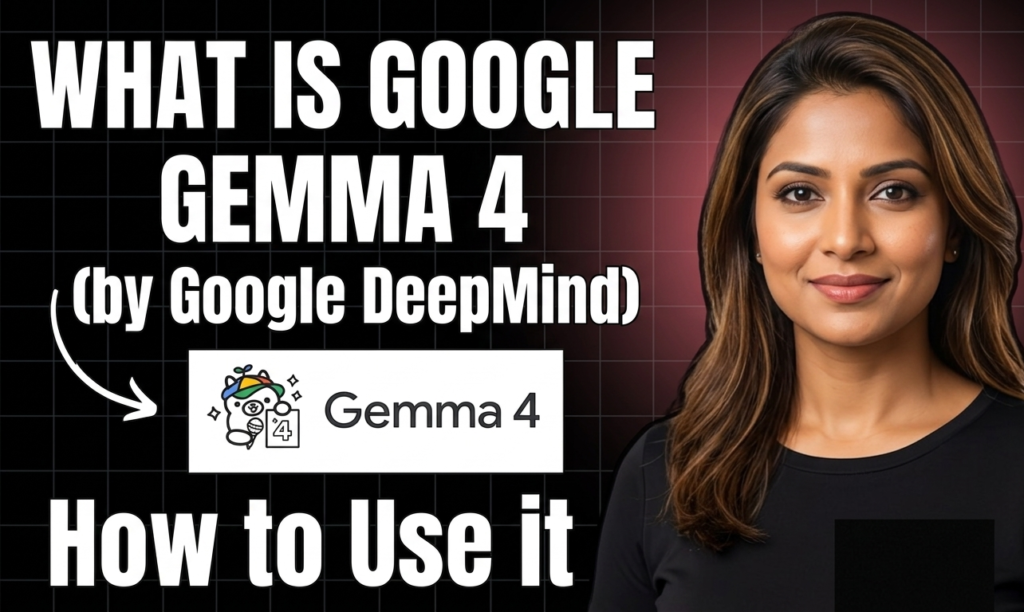
Whether you’re a machine learning engineer evaluating your next deployment stack, a product team exploring on-device AI, or simply someone trying to understand what Google Gemma is and why it matters, this article breaks it all down — from architecture and benchmarks to real-world applications and what sets Gemma 4 apart from every model that came before it.

What Is Google Gemma?
Google Gemma is a family of open-weight, lightweight large language models developed by Google DeepMind. Unlike proprietary models locked behind API paywalls, Gemma models are released with open weights — meaning developers can download, fine-tune, and deploy them in their own infrastructure without restrictions tied to commercial access tiers.
Introduced in February 2024, the original Gemma models were built using the same research and technology stack that powers Google’s flagship Gemini models. Designed to be “best-in-class for its size,” Gemma emphasizes responsible AI deployment alongside raw performance. The name itself is derived from the Latin word for “gemstone” — a nod to Google’s broader Gemini ecosystem. Since its debut, the family has expanded rapidly, with Gemma 4 representing the most ambitious leap yet.
Insight: The shift toward high-performance open-weight models like Gemma 4 democratizes “sovereign AI,” allowing organizations to maintain full data privacy and operational control without sacrificing the reasoning capabilities of frontier models.
What’s New in Gemma 4?
Gemma 4 is not an incremental update. It represents a fundamental architectural rethink, introducing capabilities that push it squarely into enterprise and research-grade territory while preserving the efficiency that made earlier Gemma models popular.
Key innovations in Gemma 4 include:
- Mixture of Experts (MoE) Architecture: Gemma introduces MoE for its larger variants, enabling dramatically better performance without proportional compute costs.
- Expanded Context Window: The model supports up to 128K tokens of context, enabling long-document processing, multi-turn reasoning, and complex code generation at scale.
- Native Multimodal Support: For the first time in the Gemma family, vision capabilities are baked directly into the architecture rather than added as an external adapter.
- Improved Instruction Following: Gemma demonstrates tighter alignment with human instructions, reducing hallucination rates in structured output tasks.
- ShieldGemma 4 Integration: Google released updated safety classifiers designed to work in tandem with Gemma for responsible deployment.

Gemma Model Variants: Sizes and Configurations
Google DeepMind released Gemma 4 in multiple size tiers to serve different deployment needs:
| Variant | Parameters | Architecture | Best For |
| Gemma 4 2B | 2 Billion | Dense | On-device, mobile, edge |
| Gemma 4 9B | 9 Billion | Dense | Mid-range consumer GPU |
| Gemma 4 27B | 27 Billion | MoE | Enterprise, research |
The 2B variant is optimized for on-device inference — including smartphones and edge hardware — making it one of the most capable small models available for local deployment. The 27B MoE variant, meanwhile, punches well above its weight in hosted environments, outperforming models twice its parameter count on key reasoning and coding tasks.
Gemma 4 Vision: Multimodal Capabilities Explained
One of the most significant additions is Gemma 4 vision — native multimodal processing that allows the model to interpret and reason about images alongside text. Previous generations relied on PaliGemma, a separate model, but Gemma 4 consolidates this by handling visual inputs within a single architecture.
What Can Gemma 4 Vision Do?
- Image Captioning and Description: Generate detailed, contextually accurate descriptions of photographs, diagrams, or screenshots.
- Document and Chart Analysis: Extract structured insights from tables, infographics, and scanned documents.
- Visual Question Answering (VQA): Answer natural language questions grounded in image content.
- Multi-image Reasoning: Compare or analyze multiple images in a single prompt — a critical capability for medical imaging and research.

Benchmark Performance: How Does Gemma 4 Stack Up?
Raw numbers matter in AI evaluation. Here is how Gemma’s key variants performed across standard industry benchmarks:
- MMLU (Knowledge and Reasoning): Gemma 4 27B scored above 85%, outperforming several 70B-class dense models.
- HumanEval (Coding): The 27B variant achieved pass@1 scores above 72%, placing it among the top open models for code generation.
- MT-Bench (Instruction Following): Gemma 4 9B scored competitively against models like Mistral 8x7B despite having fewer active parameters.
- MMMU (Vision-Language): Gemma 4’s vision-capable variants scored within a few points of GPT-4V on several subcategories.
Insight: The efficiency of the 27B MoE architecture allows it to deliver performance traditionally reserved for much larger models, significantly lowering the “compute tax” for high-end AI applications.

Practical Applications of Gemma
The architecture improvements in Gemma translate into tangible real-world use cases:
- Enterprise Document Processing: With a 128K context window, Gemma can ingest large contracts or research papers to extract structured insights in a single pass.
- On-Device AI Assistants: The 2B variant is compact enough for flagship Android devices, enabling fully private, offline AI assistants for healthcare or legal applications.
- Code Generation and Review: Development teams can deploy the 27B variant locally for proprietary codebase assistance without sending sensitive code to external APIs.
- Multilingual Customer Support: Gemma demonstrates strong performance across European and Asian languages, aiding global automation.
- Research and Academic Tooling: The open-weight release allows institutions to fine-tune the model on domain-specific datasets without commercial licensing barriers.
Gemma 4 vs. Competitors: A Quick Comparison
| Model | Developer | Open Weights | Vision | Max Context | MoE |
| Gemma 4 27B | Google DeepMind | ✅ | ✅ | 128K | ✅ |
| Llama 3.1 70B | Meta | ✅ | ❌ | 128K | ❌ |
| Mistral 8x22B | Mistral AI | ✅ | ❌ | 64K | ✅ |
| Phi-3 Medium | Microsoft | ✅ | ✅ | 128K | ❌ |
Gemma 4 is currently one of the only open-weight models to combine MoE efficiency, native vision, and a 128K context window simultaneously — a combination that no direct open-source competitor currently matches at equivalent scale.
How to Get Started with Gemma 4
Getting access to Gemma 4 is straightforward for developers already familiar with the Hugging Face ecosystem:
Step 1
Visit the official Gemma model page on Hugging Face (google/gemma-4-27b-it) and accept the usage terms.
Step 2
Install the Transformers library with pip install transformers accelerate.
Step 3
Load the model using the standard AutoModelForCausalLM pipeline with your authentication token.
Step 4
For vision tasks, use the AutoProcessor class to handle image-text interleaved inputs.
Step 5
For production deployment, use optimized checkpoints through Vertex AI or Google AI Studio.

FAQ
What is the difference between Gemma and Gemini?
Gemma is Google DeepMind’s family of open-weight models available for public download and deployment. Gemini is Google’s proprietary, closed model family powering products like Search AI.
Is Gemma 4 free for commercial use?
Yes. Gemma 4 is released under the Gemma Terms of Use, which permit commercial use for most applications. Large organizations may need to apply for expanded access.
Can Gemma 4 run on a consumer GPU?
The 2B and 9B variants run comfortably on consumer GPUs with 16GB VRAM (like the RTX 4070). The 27B MoE variant performs best on A100 or H100 hardware, though quantized versions can reduce requirements.
How does Gemma 4 compare to Llama 3?
In most benchmarks, Gemma 4 27B outperforms Llama 3.1 70B on reasoning and coding tasks despite having fewer parameters, largely due to its MoE architecture.
Conclusion
Gemma 4 marks a defining moment for open AI development. By combining Mixture of Experts efficiency, native multimodal vision, and a 128K context window into a single open-weight release, Google DeepMind has delivered a model that rivals closed commercial offerings while remaining accessible to every developer.
For organizations evaluating AI infrastructure, Gemma 4 represents a rare opportunity: enterprise-grade capability without vendor lock-in or proprietary opacity. The question is no longer whether open AI models can compete with closed ones — Gemma 4 has answered that definitively.
See More Trending Topics Breakdown on Our Blog.