On March 11, 2026, Elon Musk delivered a bombshell announcement on X that sent shockwaves through the enterprise software landscape. He publicly unveiled Macrohard, a highly ambitious joint project between Tesla and his AI startup, xAI. Musk made a blunt, paradigm-shifting claim: the system is capable of emulating the core functions of entire companies.
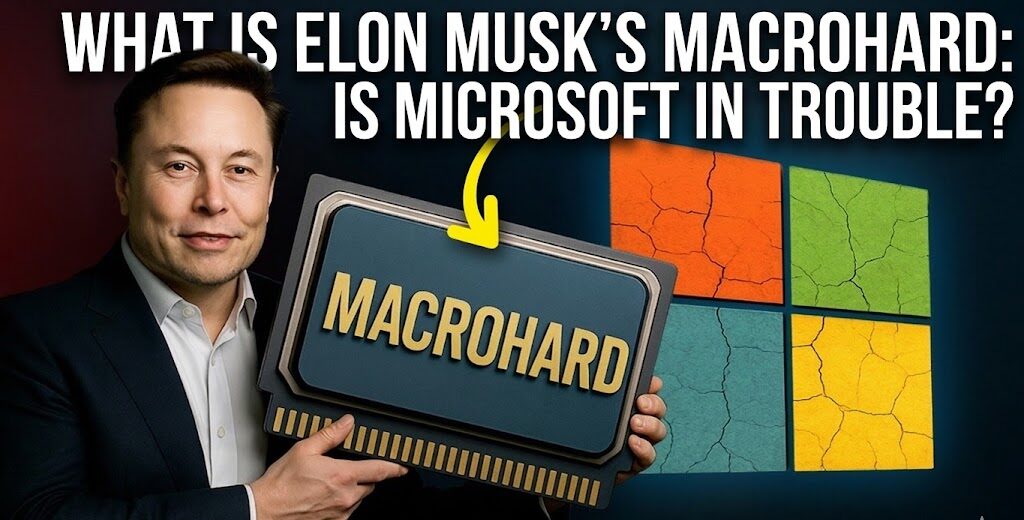
The name alone acts as a deliberate provocation to the tech establishment. Macrohard is a direct, antagonistic inversion of Microsoft—Micro becomes Macro, Soft becomes Hard. It clearly signals Musk’s long-term intent. This is not merely another productivity app or coding copilot. This is a direct, structural challenge to the foundational architecture of modern software businesses.
In this comprehensive guide, you will learn exactly what Macrohard is, how its dual-process system works under the hood, why it is structurally compared to Microsoft, and what role “Digital Optimus” plays in the ecosystem. We will also explore the real-world risks, hardware advantages, and massive opportunities this presents for investors, developers, and global enterprises in 2026.
What Is Macrohard?
Macrohard represents a convergence of hardware and artificial intelligence. It is a joint project between Tesla and xAI, described fundamentally as a system capable of emulating the functions of software companies.
Musk announced the initiative publicly on March 11, 2026. He positioned it as the first major, commercial deliverable to emerge from Tesla’s substantial financial partnership with xAI.
Under the hood, the project pairs xAI’s powerful Grok large language model with a proprietary, Tesla-developed AI agent. Grok acts as a high-level “navigator,” while the Tesla AI agent processes real-time computer screen video and executes keyboard and mouse actions.
In plain terms: Macrohard watches a computer screen the exact same way a human employee does, understands the contextual intent of what is happening, and then autonomously takes actions using a digital keyboard and mouse. Crucially, it does this without needing custom APIs or specialized software integrations.
Insight: The transition from API-dependent AI to visual-first, interface-level AI is a watershed moment. By interacting with software exactly as humans do, agentic systems bypass years of integration bottlenecks, instantly making legacy software universally compatible with AI automation.
The core concept is to create a universally capable AI platform that carries out the types of tasks normally performed by human employees. The AI could theoretically operate complex financial spreadsheets, write and test code, manage customer service communication tools, or navigate dense enterprise software ecosystems completely autonomously.

The Name Explained: Macrohard vs. Microsoft
The branding strategy behind the project is both deliberate and confrontational. Musk openly explained that the name carries an antagonistic nuance, created by deliberately reversing Microsoft (Micro+Soft) into Macro+Hard.
“In principle, it is capable of emulating the function of entire companies. That is why the program is called MACROHARD, a funny reference to Microsoft,” Musk stated.
The breadcrumbs for this announcement were dropped months prior. In August 2025, Musk posted a message urging his followers to “join @xAI and help build a purely AI software company called Macrohard”. He noted at the time that while it was a tongue-in-cheek name, the project was very real.
He elaborated on the core philosophy: “In principle, given that software companies like Microsoft do not themselves manufacture any physical hardware, it should be possible to simulate them entirely with AI”. Records from the U.S. Patent and Trademark Office confirm this trajectory, showing that xAI filed a trademark application for the name “Macrohard” in August 2025. This confirms it was an active internal project for over six months prior to its public reveal.
The underlying argument is provocative but highly coherent. Software companies essentially produce code, manage digital data, and coordinate human capital. If highly advanced AI agents can execute all three of these tasks autonomously, the existing, labor-heavy model for enterprise software becomes structurally fragile.

How Digital Optimus Powers the System
Elon Musk’s Macrohard operates seamlessly under a second, operational identity: Digital Optimus.
The name draws direct inspiration from Tesla’s physical humanoid robot project, Optimus. However, it applies the exact same concept of autonomous labor to the digital workspace.
As Musk detailed on X: “Macrohard or Digital Optimus is a joint xAI-Tesla project, coming as part of Tesla’s investment agreement with xAI”. He further explained that Grok serves as the master conductor with a deep understanding of the world, directing the digital Optimus, which actively processes and actions the past five seconds of real-time computer screen video alongside keyboard and mouse inputs.
Think of Digital Optimus as the ultimate virtual employee. It never sleeps, never takes breaks, and can be infinitely deployed across thousands of routine and complex tasks simultaneously.

The Dual-Process Architecture: System 1 and System 2
The technical framework of Elon Musk’s Macrohard brilliantly mirrors a well-established model from cognitive psychology—specifically, the dual-process theory popularized by Daniel Kahneman. Musk explicitly framed the system’s architecture this way.
Musk described the technical division of labor using this cognitive model: “You can think of it as Digital Optimus AI being System 1 (instinctive part of the mind) and Grok being System 2 (thinking part of the mind)”.
Here is how that plays out in functional deployment:
- System 1 (Digital Optimus / Tesla AI Agent): This layer acts fast and reacts instantly. It handles execution-level tasks by processing the past five seconds of live screen activity, translating visual data into immediate mouse movements and keystrokes.
- System 2 (Grok / xAI): This layer handles complex strategic reasoning, global world knowledge, and multi-step, long-term planning. It functions exactly like a senior human decision-maker, directing the overall workflow.
When these systems are fused together, they create a remarkably powerful AI-based assistant capable of completing everything from tedious accounting data entry to complex HR compliance tasks. Musk further described Grok’s role in this dynamic as “a much more advanced and sophisticated version of turn-by-turn navigation software”.
This division of labor is technically critical. It successfully bridges the gap that has historically plagued AI development: the ability to handle rapid, real-time responsiveness while simultaneously executing complex, multi-step reasoning.
Insight: Splitting AI into execution (System 1) and reasoning (System 2) drastically reduces computing latency. The agent does not need to query a massive LLM for every single mouse click; it only consults the LLM when it encounters a strategic roadblock or requires next-step planning.
The Hardware Advantage: Tesla AI4 Chip
Perhaps the most underreported, yet structurally vital, aspect of Macrohard is the hardware infrastructure that makes it economically viable at scale.
The system operates primarily on Tesla’s low-cost AI4 inference chip. This strategically minimizes reliance on the highly expensive Nvidia resources utilized by xAI, ensuring competitive, real-time performance without prohibitive cloud computing costs.
Musk highlighted this economic moat: “This will run very competitively on the super low cost Tesla AI4 ($650) paired with relatively frugal use of the much more expensive xAI Nvidia hardware”. At merely $650 per unit, the AI4 chip transforms large-scale deployment of Elon Musk’s Macrohard agents into a financially realistic endeavor—one that heavily GPU-dependent competitors will struggle to match.
Furthermore, Tesla plans a massive infrastructure play by deploying several million dedicated Digital Optimus units directly at their Supercharger sites. The available power capacity of this network is staggering, sitting at roughly 7 gigawatts.
By turning physical vehicles and existing EV charging infrastructure into distributed AI computing hubs, Tesla effectively secures a vast, decentralized AI computing grid without the need to build separate, multi-billion-dollar large-scale data centers. This distributed compute strategy arms Tesla and xAI with a structural and economic advantage that is extraordinarily difficult for industry rivals to replicate quickly.

Macrohard vs. Microsoft: A Structural Comparison
To understand the threat vector Macrohard represents, we must compare it to traditional software titans like Microsoft.
| Feature | Microsoft | Macrohard (Digital Optimus) |
| Core Model | Human-operated software | AI-operated agentic system |
| Interface | APIs, GUIs | Real-time screen observation |
| Hardware Dependency | Third-party chips | Proprietary Tesla AI4 chip |
| Cost Model | Subscription SaaS | Low-cost inference at scale |
| AI Integration | Copilot (assistive) | Fully autonomous execution |
| Current Scale | Global enterprise deployment | Early-stage project, 2026 |
Microsoft’s leadership previously boasted that artificial intelligence already generates more than 30 percent of the company’s code. Musk’s counter-argument is lethal in its simplicity: if AI is already writing the vast majority of the code, the human workforce managing that process is essentially a removable layer. Macrohard is explicitly designed to remove it.
Who Else Is Building Agentic AI?
Macrohard does not exist in a vacuum. The agentic AI space is rapidly evolving into one of the most highly competitive and well-funded segments in the global tech industry.
Reuters recently noted that the launch of similar autonomous systems, such as Anthropic’s Claude Cowork, has sparked significant anxiety among enterprise software investors. Wall Street is waking up to the reality that AI agents could aggressively disrupt traditional, high-margin software business models.
Several major tech conglomerates are racing to secure market share:
- OpenAI Operator: Specifically designed to navigate web browsers and perform complex tasks autonomously.
- Google DeepMind’s Project Mariner: Heavily focused on perfecting agentic browser interactions.
- Microsoft Copilot Studio: Allows businesses to integrate AI agents directly within existing Microsoft enterprise workflows.
- Anthropic Claude: Increasingly capable of raw computer use and executing multi-step task workflows without human intervention.
What uniquely positions Elon Musk’s Macrohard apart from this crowded field is its intense vertical integration. While most competitors are heavily reliant on third-party cloud compute platforms, Musk’s ecosystem is built entirely on proprietary silicon, proprietary foundational models, and a massive proprietary hardware distribution network.

Internal Challenges: Leadership Chaos and Staff Departures
Despite the aggressively bold vision, Macrohard is currently battling severe internal friction. Behind Musk’s flashy technological promises lies a mounting pile of unresolved operational challenges. This includes a glaring leadership vacuum, the sudden departure of critical engineering staff, and a reported halt in vital data collection.
The Macrohard project has suffered from immense instability, having had its leadership replaced multiple times since its quiet inception. In February alone, two senior project leaders abruptly quit . xAI co-founder Toby Pohlen stepped in to take over the division, but shockingly left the company after just 16 days in the role.
Furthermore, of the approximately 20 engineers identified as belonging to the Elon Musk’s Macrohard team on platforms like LinkedIn and X, the majority are believed to have either quit entirely or transferred to other internal teams in recent months.
Compounding the technical brain-drain are fierce legal battles. Tesla shareholders are currently actively pursuing a lawsuit against Musk for breach of fiduciary duty. The lawsuit alleges that Musk inappropriately siphoned Tesla’s highly valuable AI personnel and hardware resources over to xAI.
These are not trivial corporate concerns. High-stakes, frontier AI projects absolutely demand stable leadership and a sustained, focused engineering effort. The repeated, high-profile turnover at the very top of Macrohard raises legitimate, critical questions regarding their ability to meet execution timelines.
However, while Musk deliberately abstained from announcing a firm public release timeline for the platform, he heavily suggested the underlying technology could represent a massive, significant leap forward in real-time AI capabilities. “And it will be the only real-time smart AI system. This is a big deal,” Musk stated.
What This Means for Enterprises and Software Markets
For corporate executives and boards evaluating their AI strategy in 2026, Macrohard simultaneously represents a massive opportunity and a blaring warning signal.
The Opportunity: If the Macrohard platform delivers even a fraction of its stated autonomous capabilities, it has the potential to dramatically slash the cost of back-office operations, customer support infrastructure, routine data entry, and bespoke software development.
The Warning: Any enterprise deeply embedded in traditional SaaS ecosystems—like Microsoft, Salesforce, or SAP—needs to rigorously monitor how agentic AI evolves. Systems that interact with enterprise software natively at the visual interface level, rather than through officially approved and metered APIs, could create complex compliance, security, and corporate liability questions that global regulators have simply not yet addressed.
Furthermore, this launch indicates a massive pivot. Tesla has effectively formalized its strategic shift from a pure electric vehicle manufacturer into an expansive AI platform company. Macrohard serves as a foundational puzzle piece in that multi-trillion-dollar transition strategy.
Read our detailed guide on What Is Agentic AI and How to Build your Own.
FAQ
1. What is Macrohard?
Macrohard is a highly ambitious, joint AI project developed between Elon Musk’s AI startup, xAI, and Tesla. It is engineered to autonomously execute complex, computer-based tasks. It achieves this by combining xAI’s Grok language model with a proprietary Tesla-built AI agent that visually observes and directly interacts with a computer screen in real time.
2. Why is it called Macrohard?
The branding is a deliberate, antagonistic reversal of the name “Microsoft” (Micro+Soft becomes Macro+Hard). While Musk has publicly described the naming convention as a humorous, tongue-in-cheek jab, the fundamental intent of the project—to completely replicate the core functions of legacy software companies using autonomous AI—is highly serious.
3. What is Digital Optimus?
Digital Optimus serves as the alternate, operational name for Macrohard. Specifically, it refers to the Tesla-developed AI agent component of the broader system. It acts as the rapid, execution-layer element, conceptually analogous to Tesla’s physical Optimus humanoid robot, but meticulously applied to navigate digital software environments.
4. How does Macrohard work technically?
The platform utilizes a sophisticated dual-process architecture. Grok, powered by xAI, functions as the strategic, high-level reasoning layer (System 2). Simultaneously, the Tesla AI agent handles the immediate processing of live screen video and peripheral input data in real time (System 1). Working seamlessly together, they allow the system to autonomously navigate complex software environments without the need for any custom API integrations.
5. Is Macrohard a direct competitor to Microsoft?
The branding explicitly implies a highly competitive, adversarial stance, and Musk has directly stated that the ultimate goal is to emulate the core function of software companies like Microsoft. However, it is important to note that Macrohard remains an early-stage developmental project in 2026, whereas Microsoft operates as a fully deployed, highly entrenched global enterprise platform.
6. What hardware does Macrohard use?
To achieve economic viability, the system primarily runs on Tesla’s proprietary, low-cost AI4 inference chip, which is priced at approximately $650 per unit. This localized processing is then supplemented by high-powered Nvidia servers utilized by xAI for complex reasoning tasks. This hybrid hardware combination is specifically designed to make massive, large-scale deployment incredibly cost-efficient.
7. Are there risks associated with the Macrohard project?
Yes, significantly. Internally, the project has suffered through multiple sudden leadership changes, the departure of key engineering staff, and a reported halt in essential data collection. Furthermore, Tesla shareholders have filed legal lawsuits alleging the improper misuse and transfer of corporate resources to xAI. These compounding internal and legal challenges raise highly legitimate questions regarding the project’s realistic execution timeline and its overall long-term viability.
Conclusion
Macrohard easily stands as one of the most structurally ambitious and disruptive AI projects announced in 2026. The foundational premise—that a distributed fleet of AI agents, powered by Grok’s strategic reasoning and executed via Tesla’s proprietary inference chips, could entirely replicate the operational output of legacy software companies—is polarizing. Depending on the analyst you ask, it is either brilliantly visionary or dangerously overreaching.
However, what is entirely undeniable is the system’s structural logic. Software companies fundamentally rely on expensive human employees to write code, manage digital data, and operate complex tools. If autonomous AI systems can now execute all three of these core functions at a drastically lower cost and exponentially higher speed, incumbent tech monopolies face a genuine, existential long-term threat.
Macrohard is Elon Musk’s billion-dollar bet that the window for absolute software disruption is officially open. Whether Digital Optimus actually scales to become the dominant system that redefines global enterprise software, or if it simply becomes another highly ambitious moonshot derailed by complex execution problems, is yet to be determined. But the urgent conversation it has sparked is one that every CTO, tech investor, and software developer must be having right now.
Want to stay ahead of the rapidly accelerating agentic AI revolution? Explore our highly detailed, in-depth guides covering emerging AI tools, autonomous digital systems, and the future landscape of digital work at Our Blog.